


 Bartosz Ziemski archive
Himalaya roundup 2026: Bartek Ziemski, Hillary Dawa Sherpa and the 1008 ascents of Everest

 Copia link
 1 / 13Bartosz Ziemski archive
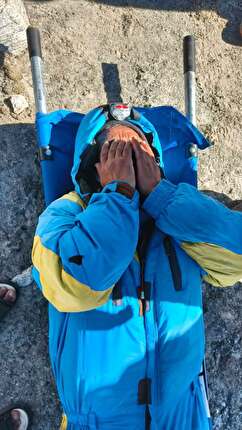
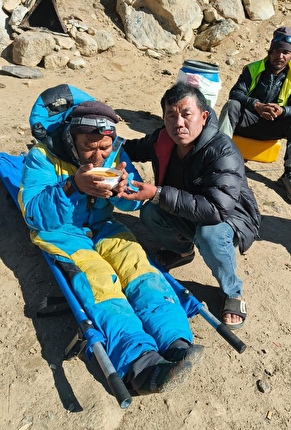
The Himalayan spring season had two undisputed and unexpected protagonists. Plus a "half" – and I say this to his credit. I am referring to the Russian Rustam Nabiev, who climbed Everest using only the strength of his arms, having no legs – they were amputated in 2015 after the roof of the barracks where he was sleeping collapsed.
The two protagonists mentioned are the ones who, on 12 May, opened the floodgates for the highest peaks of the Khumbu region with his ascent of Lhotse, and the one who, on 4 June closed the season with a sensational twist at the foot of Everest.
The first is of course Poland's Bartek Ziemski, who, as we shall see, confirmed that he, even before being a highly talented extreme skier, is a great, real alpinist. The second is a humble Sherpa: "Hillary" Dawa. His ordeal, which I have already reconstructed in detail, is so incredible that it quickly made headline news across the globe. So much so that it even overshadowed the news of yet another record number of Everest summits in a single season: 1,008 (compared to 5 deaths) – all from the Nepalese side alone, while awaiting news from the "mysterious" Tibetan side (currently closed to foreigners). Furthermore, as if that were not enough, there were also 274 summits in a single day, on 20 May. The previous records stood at 877 total ascents of the Roof of the World (from both sides) and 223 in a single day, both in May 2019.
Of the thousand or so climbers who relied on supplemental oxygen for their ascents – read clients and their Sherpas – only six are believed to have reached the Roof of the World without using O2. The list includes Kami Rita Sherpa on his 32nd Everest summit, Pasang Dawa Sherpa who climbed it twice this season to reach a total of 31, and Britain's Kenton Cool – the man who sent the first tweet from the summit back in 2011 – now on his 20th ascent. However, I would only put my money on the aforementioned Pole, Bartek Ziemski. He was alone and climbing completely autonomously, which meant he couldn't carry oxygen bottles alongside his skis.
The others reportedly without O2 are the two Ecuadorians Fredy Inty Tipán (accompanying a client) and Marcelo Segovia, the famous Nepalese Nirmal Purja, who then doubled his takings by tagging the summit of Lhotse (in just 13 hours, 42 minutes and 17 seconds – roughly twice the "record" with O2, but nevertheless still an exceptional physical feat). Nims then also climbed Makalu and, according to his own calculations, has now summited an 8000er a staggering 56 times (exactly half, 28, without using O2).
With him on Everest without supplemental oxygen was Nikol Kovalchuk from Russia. The sixth ascent of the Roof of the World without resorting to bottled oxygen is reportedly that of a climber who was actually aiming for something completely different, namely a project that had been much talked about and is becoming increasingly fashionable, even though stricly speaking it is now devoid of any mountaineering meaning. I'm talking about the Triple Crown, ie the ascent of Everest, Lhotse and Nuptse in a single season.
It was Norway's Kristin Harila, the quintessential "climbinfluencer", who announced the project to become the first to achieve this triplet without supplemental oxygen. But, after a series of hollow proclamations, she ended up using oxygen on Lhotse. However, she states she did without O2 on Everest – curious. Especially since she was always in good Sherpa company.
In any case the "Triple Crown", first achieved in 2013 by the aforementioned Kenton Cool and subsequently repeated about ten times, was completed this spring on the "pistes" prepared by Sherpas on all three mountains by Vietnam's Ngô Hải Son, together with Nima Sherpa.
Whil on the subject of announcements, America's highly sponsored Tyler Andrews returned to the Himalayas this season to attempt – by his own account – a speed ascent of Everest without supplemental oxygen. However, during an early ascent, on reaching Camp 2, he promptly changed his mind and used O2 up to 8,400 metres, where he then decided to abandon his attempt. Then, a few days later, he set off on a speed record, with plenty of supplementary oxygen however (a flow of 4 litres per minute starting from Camp 2)… The attempt was successful (in 9 hours, 55 minutes and 43 seconds), obviously. The differences compared to 23 years ago are enormous, when Lhakpa Gelu Sherpa, with far less support and using less efficient oxygen bottles from Camp 4 onwards, needed 10 hours, 56 minutes and 46 seconds. In short, two physical performances that are simply not comparable.
Far more "correct" was the attempt without supplemental oxygen by Ecuador's Karl Egloff, who climbed with no "safety" bottles whatsoever. His attempt ended at the South Col, when his pace had slowed too much and his compatriot and climbing partner Nicolás Miranda was beginning to encounter problems.
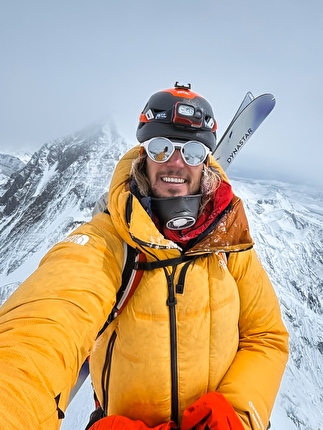
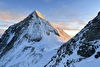
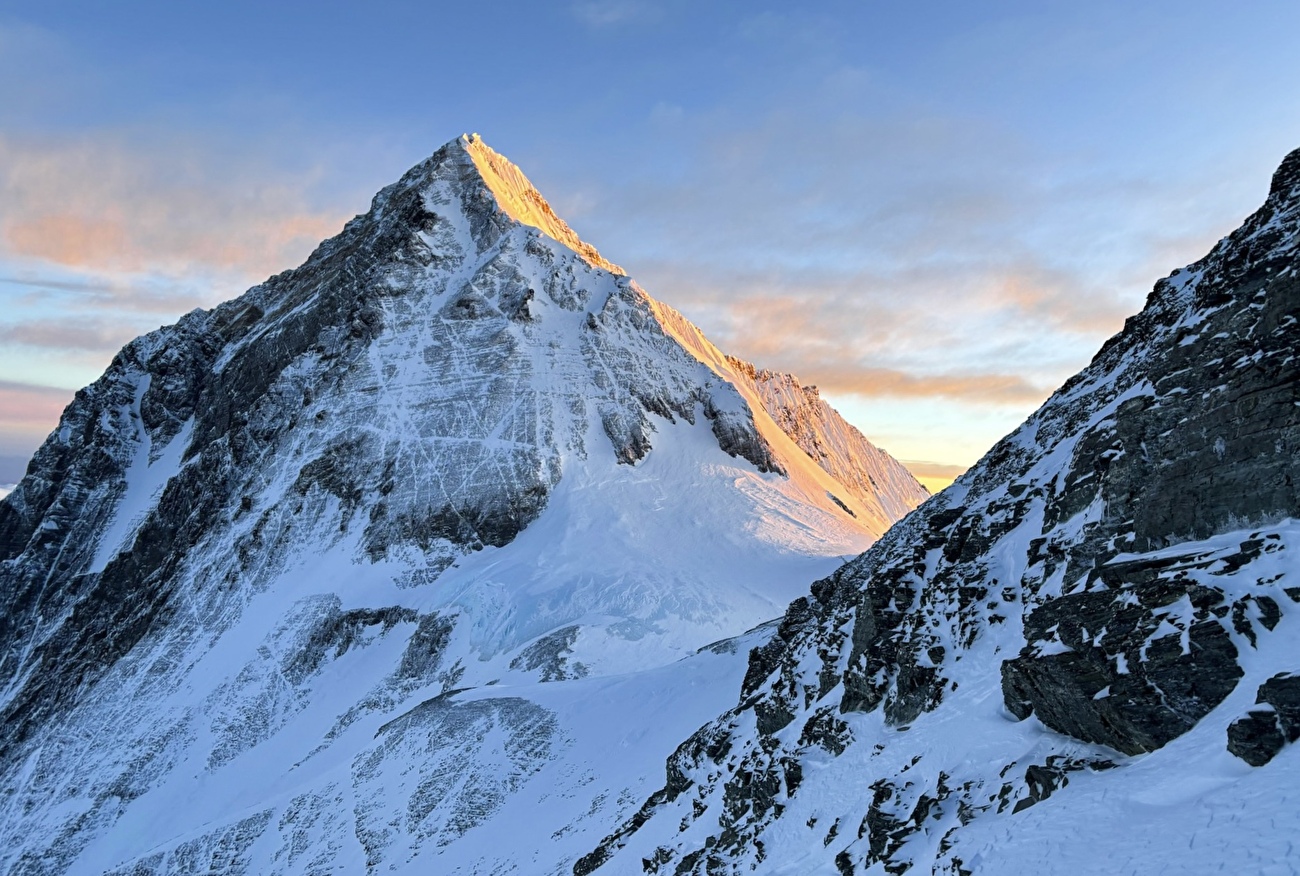
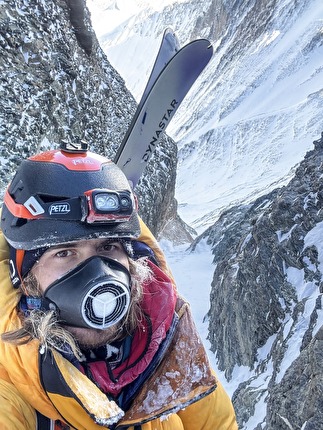
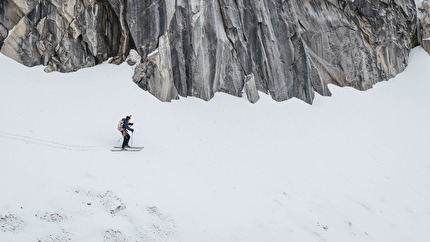
So now we come to the first of the true protagonists mentioned at the start of the article. Bartek Ziemski confirmed his qualities as a true mountaineer by climbing Lhotse with his compatriot Oswald Rodrigo Pereira, and then Everest on his own. On both occasions he then made complete ski descents, for which he was rightly celebrated. Skilful, without doubt. In many ways he seems truly predestined, especially considering his surname which, after the root that recalls the earth (ziem in Polish), is followed by ski (this is actually a suffix used in Polish to form adjectives from nouns)…
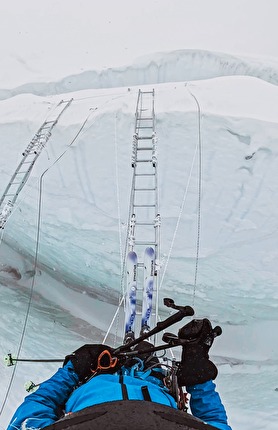
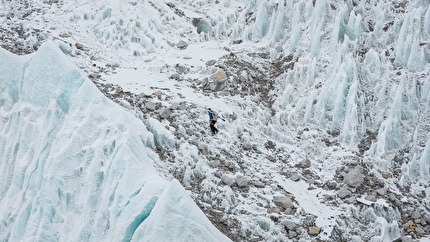
Jokes aside, the most significant part of Ziemski's double were probably the ascents themselves. Bartek climbed Lhotse before the ropes had been fixed above Camp 3. And even earlier, he had taken part in exploring the route through the Icefall. In doing so he "saved" therefore - together with five willing Sherpas - the climbing season for the bottled climbers who had been kicking their heels in frustration at Base Camp for days and even weeks while waiting for the route to be openeed. In fact, the Icefall Doctors has stated that route through the Icefall could not be opened because a serac threatened to collapse onto it at any given moment. Ziemski however, after checking the situation with a drone, had already made a recce on his own towards Camp 1; Mingma G., who believed his reassurances, provided the core of Sherpas who, together with two colleagues from other agencies, assisted the Pole in opening the most delicate passage through the maze of ice. At the end of the season the serac was still looming, even though ice melt is becoming increasingly evident.
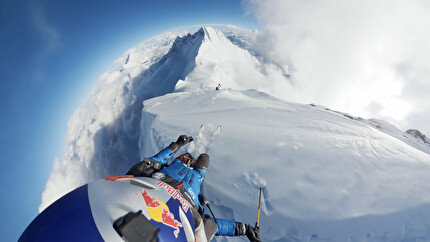
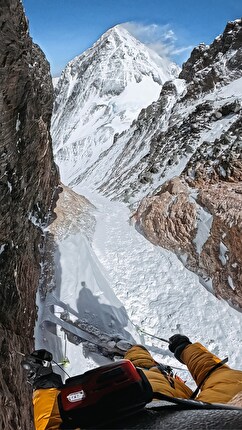
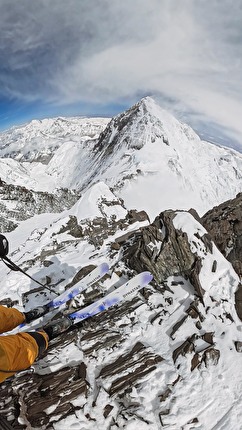
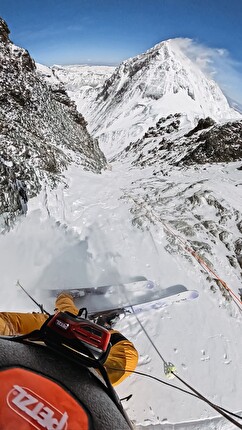
Ziemski climbed practically solo from the South Col to the summit of Everest, on a day when strong winds had discouraged the masses from leaving their tents and convinced almost all those who had made a summit push to turn around. Ziemski insisted on continuing upwards, trusting the forecasts that had prediceted a drop in winds at very high altitude. And he was right. Thus, after having the luck to encounter a Sherpa with his client near the summit and asking them to take his photo at 8,848 metres, he managed to carry out an integral ski descent. Without any assistance, as well as without supplementary oxygen, as already noted. Truly supreme.
Even though it comes after the recent descents, well‑organised and supported, carried out by America's Jim Morrison (via the Hornbein Couloir) and Poland's Andrzej Bargiel (down the Nepalese side), Ziemski's solo mission is the most comparable to the pioneering (and not complete) ski descent carried out 30 years ago down the Tibetan face by South Tyrol's Hans Kammerlander.
Bartek now boasts ski descents of nine 8000ers. Additionally, it should not be forgotten that his descents on Dhaulagiri and Kangchenjunga were first ski descents – on the latter, two years ago, he and his compatriot Oswald Rodrigo Pereira were the first to summit that season when not only had the fixed ropes not yet been placed on the upper part of the mountaion, but the Sherpas had also given up trying to fix them…
It is significant that Bartek commented on his descent from the Roof of the World by saying he was disappointed with the experience. In particular because of the view, while descending, of the long line of climbers snaking up from Camp 3 to the South Col. He explained that the mountain experience on Everest has been completely destroyed… Clearly the Pole is questing for something very personal, and not driven to sell his descents to sponsors or networks ready to extol them as the mountaineering feat of the decade.
- Alessandro Filippini, Milan, Italy
 See all photos