


 Temba Tsheri Sherpa / Facebook
Dawa Sherpa miraculously survives six days alone on Everest

 Copia link
 1 / 1Temba Tsheri Sherpa / Facebook
The pre‑monsoon Himalayan season has ended with a sensational, miraculous story of survival on the highest mountain in the world, Everest. It concerns Dawa Sherpa, known as "Hillary" Sherpa – a nickname which, contrary to what one might think, has nothing to do with his high‑altitude experience. He was on Everest hired by a minor agency, apparently not among the best‑organised of outfitters.
Together with a fellow Sherpa and their two clients – a British climber, Chris Thrall, and a Pole, Mariusz Chmielewski – Dawa attempted to summit Everest on the night of 28‑29 May. That day had been announced as the season's closing date, after which the route through the Icefall would be dismantled. They climbed very slowly. Chmielewski eventually abandoned his push, despite being not far from the summit; Thrall, however, reached the top.
On the descent, with oxygen bottles running out and the other Sherpa having gone ahead, Dawa sat down once they reached the Yellow Band area. He instructed the two clients to continue on down.
By then Chmielewski had frostbite on his hands and had run out of supplementary oxygen. Thrall, who still had a little left, helped him down towards Camp 3. When he turned to see if Dawa was catching up, he realised Dawa was still sitting where they had left him, at about 7,500 metres. Not wanting to leave the Pole without assistance, Thrall had no choice but to continue on down with him.
Even after several hours of rest at Camp 3, Dawa had not caught up with them, nor did he show up at Camp 2 the next day. From there they raised the alarm by radio, but their agency only gave them instructions on how to descend and get through the Icefall. According to Chmielewski – speaking from the Kathmandu hospital where he is being treated – no search and rescue operation was launched for Dawa because he was assumed dead.
The Pole was asked not to speak to the media, but his account to the Kathmandu Post is highly critical of the agency, Himalayan Traverse Pvt Ltd. In his view, everything was mishandled: last‑minute decisions, insufficient food supplies, and the impossibility of using all seven oxygen cylinders he had been guaranteed. Furthermore, he had been assured that the agency used only experienced Sherpas for the climb, but Dawa Sherpa allegedly told him personally that he had never been to the summit of Everest before. This was confirmed to Kantipur by Dawa's daughter, Mendo Lhamu Sherpa.
Originally, Dawa Sherpa was supposed to stay at Camp 2 to assist clients, but later he was tasked with joining them in the summit attempt. Yet, once left alone on the mountain, he managed to get himself out of the situation almost miraculously. Inexplicably – given that it was just a matter of descending the fixed ropes to Camp 2 – he never rejoined the two clients, who never saw him again. We will learn what really happened after he receives treatment in hospital. Aside from frostbite on both hands, he is being treated for severe dehydration and a state of great fatigue and, probably, confusion.
After Dawa Sherpa had been missing for more than five days, and low clouds had prevented helicopter flights for two days, a 30‑minute search flight (as far as Camp 3) was finally organised on 3 June by 8K Expeditions. Dawa, whom everyone had assumed dead, later stated he heard and saw the helicopter. However, he could not make himself seen in Icefall ice labyrinth, where he had fallen into a crevasse and remained trapped for two and a half days – until a providential avalanche created a snow ramp which enabled him to escape and continue on down. Incredibly, Dawa reached the bottom of the Icefall, also thanks to the fact that, fortunately, the five ladders tied together to create a bridge over the largest crevasse had not yet been dismantled.
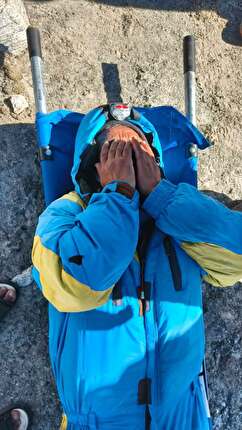
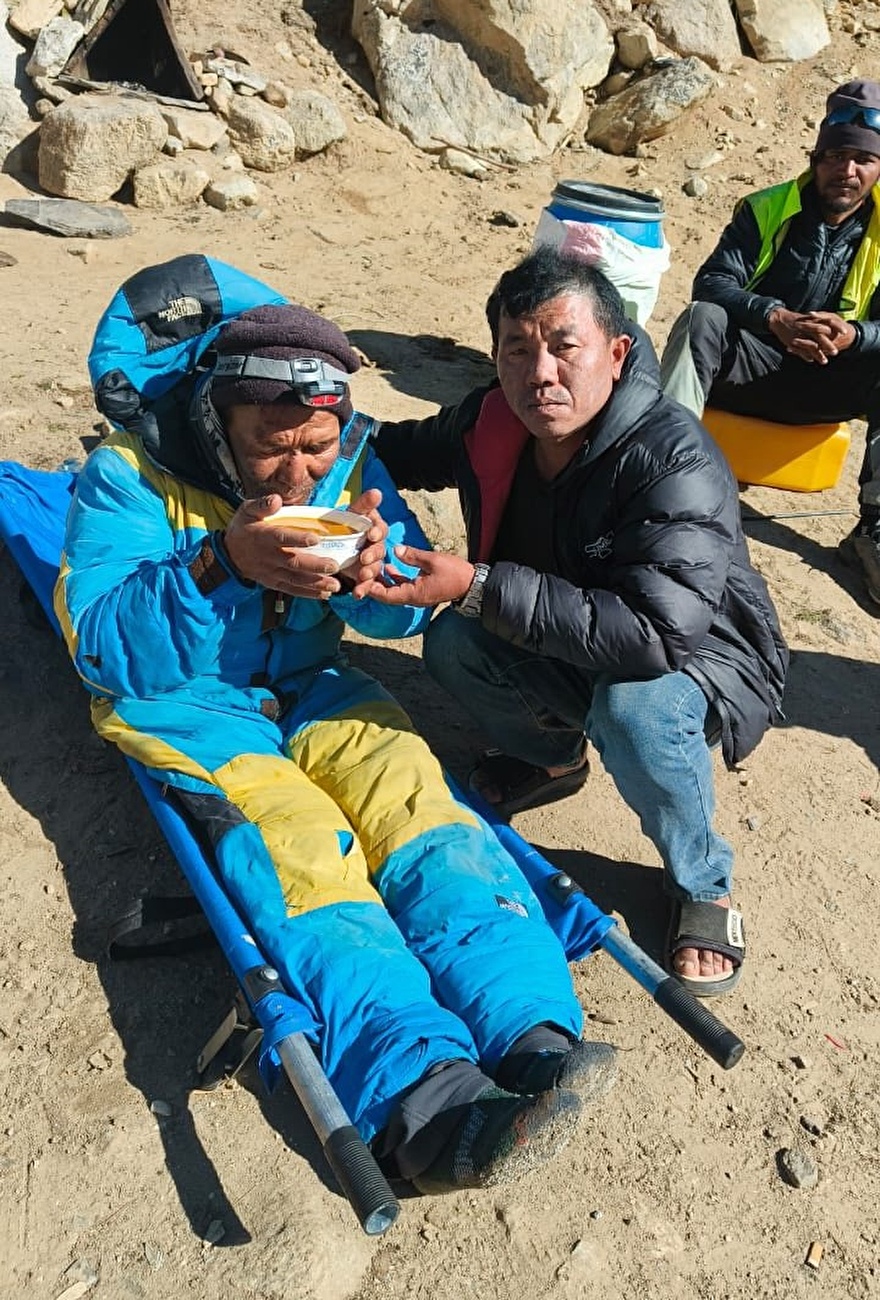
Throughout those days of despair, Hillary Dawa Sherpa had survived on the last remains of food found at Camp 3 and, during the days spent in the crevasse, on a single packet of biscuits and chewing some ice. Nevertheless, he reached the so‑called Crampon Point close to Base Camp entirely on his own. There, exhausted and with frostbitten hands, dragging himself and almost crawling on all fours, he was spotted and rescued by members of the Sagarmatha Pollution Control Committee (SPCC), who were collecting rubbish left behind at the end of the season by the commercial expeditions.
Dawa Sherpa's is an incredible story of survival. His misadventure though also sounds a further alarm about the drift towards intensive exploitation of Everest, which the Nepalese government – earning millions from high‑altitude tourism – seems unwilling to stop.
— Alessandro Filippini, Milan