


 archive Julia Cassou
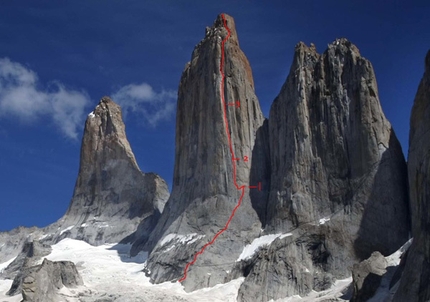
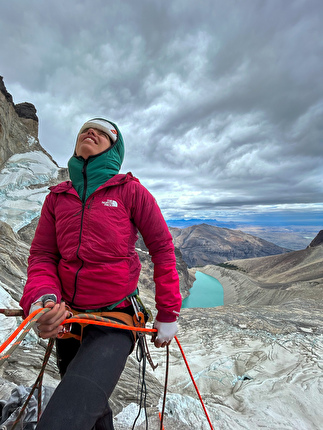
Torres del Paine South African route climbed by Julia Cassou, Amelie Kühne, Belen Prados, Caro North

 Copia link
 1 / 19archive Julia Cassou
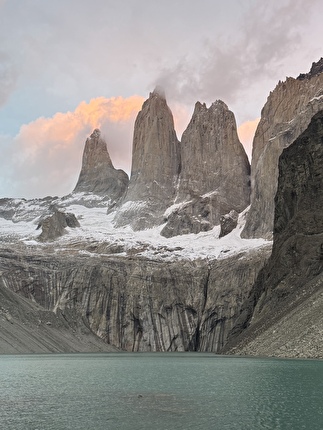
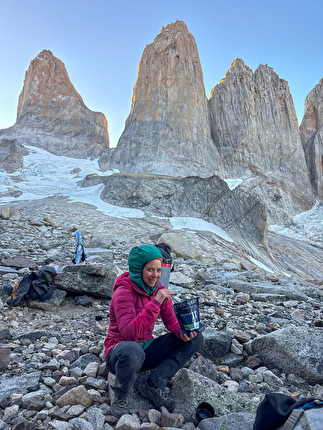
Months of planning between Bariloche, El Chaltén, the USA, and Europe. Messages, massive gear lists, anticipation, an idea slowly taking shape. Then finally: our reunion in El Calafate. We have a car far too small for what we’re about to do. Whatever doesn’t fit gets strapped on top. We continue to Puerto Natales, the last stop before the spectacular Torres del Paine, already visible from afar.
At the Redpoint Hostel, we settle in and spread out all our gear. For 20 days, it’s all about: shopping, sorting, discarding, repacking. The first haul bags are carried towards the wall, the first pitches climbed.
Our goal is clear and now right in front of us: an ascent of Torres del Paine in 17 days, via the South African route, ideally free. The preparation, but also the respect for the wall, is immense.
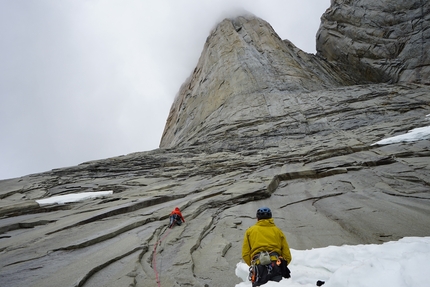
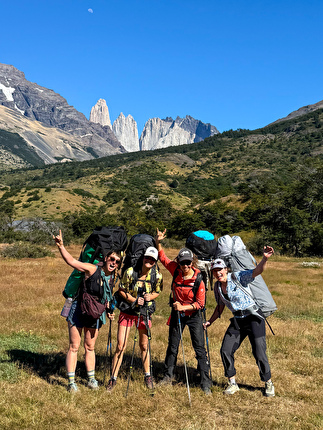
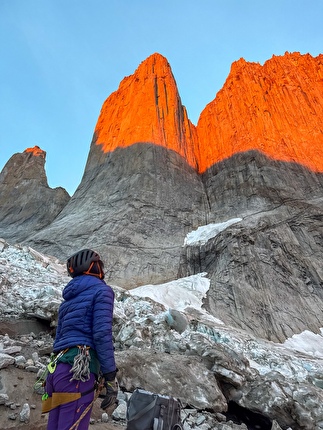
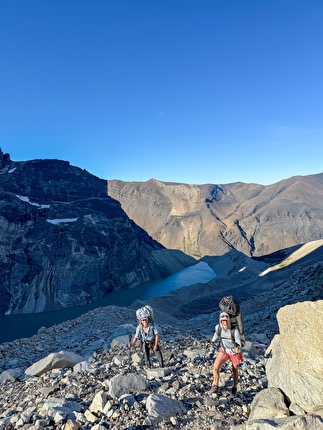
The approach: 2.5 hours to Campamento Torre, 1.5 hours to the Belgian bivouac, then another 1.5 hours over rough terrain and a snow-free glacier to the base of the wall. With up to 35 kg on our backs, every step and the total time needed become longer and at the same time more meaningful.
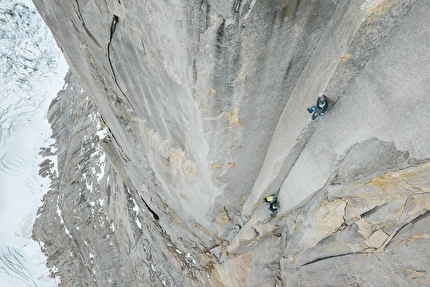
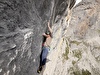
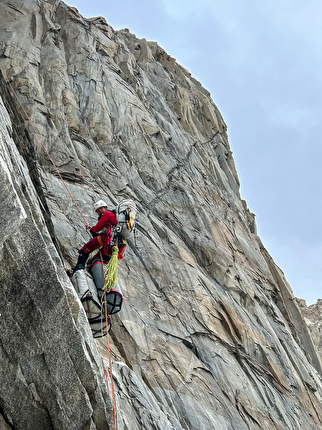
Before the final push into the wall, we fix the first pitches up to the "Shattered Pillar" (P10). A nerve-wracking start: slab climbing, rockfall, and ice coming down from above. We get creative while climbing, hammer in pitons, place micro cams, and accept long runouts. Progress is slow. We had hoped to be faster while hauling as well, but around 90 liters of water, food for almost two weeks, portaledges…—a total of seven haul bags—don’t carry themselves up the wall.
Once everything is at the "Shattered Pillar", we wait back at the hostel for good weather. In vain. It snows, blows, rains… Patagonia shows its stormy side. The days pass quickly, our plan shrinks. Seventeen days become fewer. Keep waiting or just go? We go.
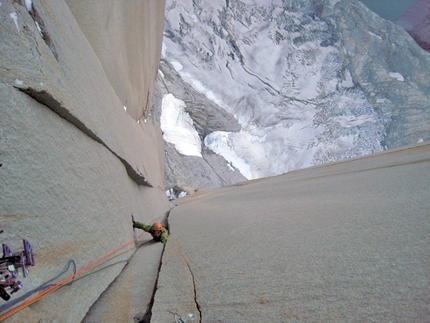
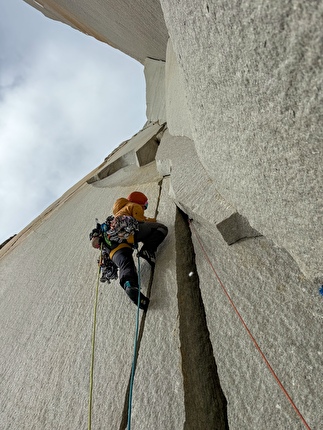
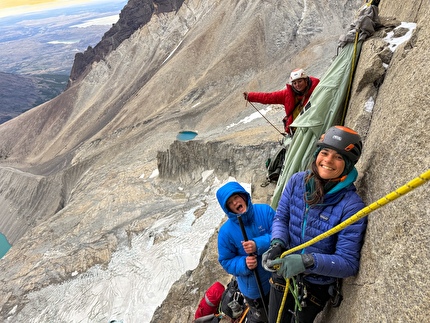
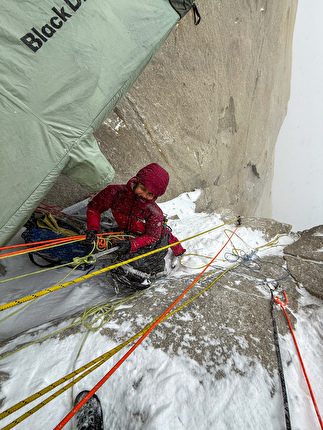
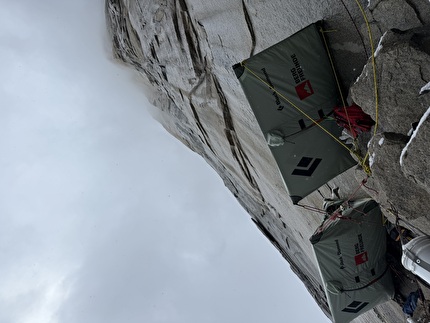
The wall greets us harshly: already on the first pitch, Belen is hit by a rock and is out for two days. From pitch 13 onward, the rock finally improves: a sustained corner, then a bouldery crux. We don’t manage everything free — the winter conditions simply don’t allow it. During the move to the "Boeing Ledge" (P18), the weather finally turns, and we are caught in a storm. Spindrift rushes past us as we try to move upward as quickly as possible. Just before, we had taken down the portaledges in sunshine… the weather here changes in a split second!
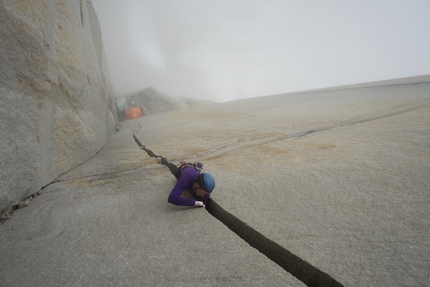
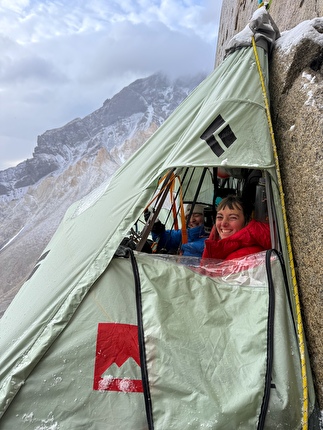
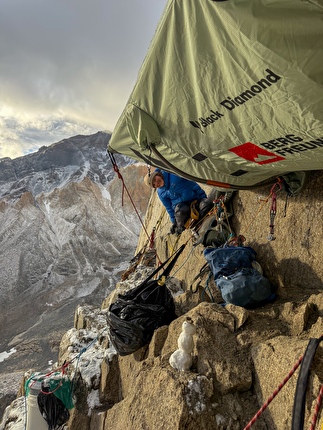
We spend a total of six nights on the "Boeing Ledge." Water now only comes from melted snow, everything is frozen. Over the next three days, we continue working our way upward. Fantastic crack climbing follows, including a legendary offwidth, which we have to climb in a snowstorm.
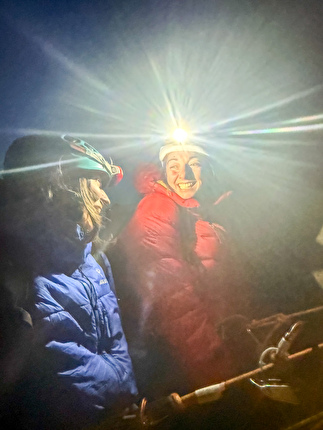
Then the final push: on summit day, we start at 4 a.m., jug 320 meters upward, hoping for sun. It comes — but with it, falling ice. After the last hard pitch, which demands everything from us once more — loose, icy, intimidating — several more pitches follow, and finally the summit ridge.
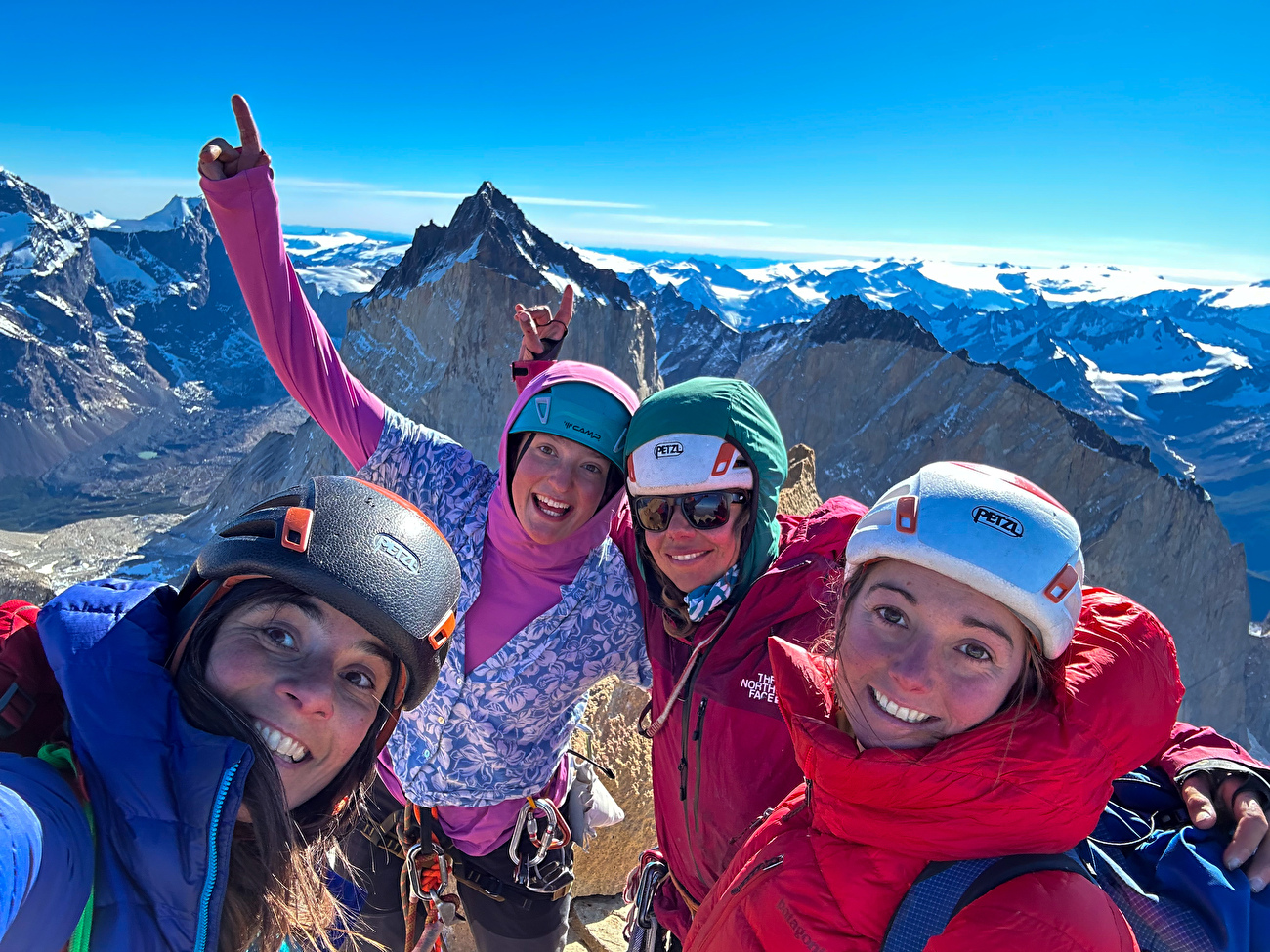
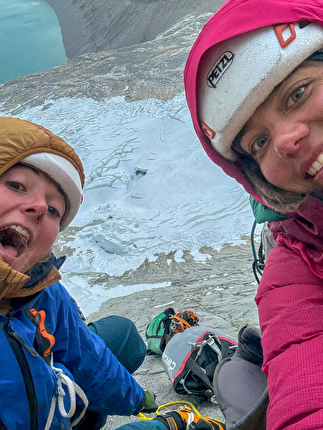
For the first time, the weather cooperates: sun and little wind give us confidence and the courage to keep going. Our feet ache from the cold, the skin splits open, but we are close. Then the final meters on beautiful cracks — and we are finally on top. No wind, warmth, silence. A moment that holds everything.
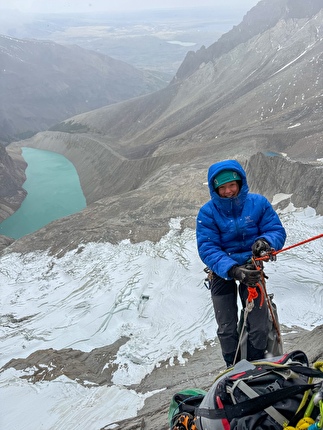
We don’t have much time. The descent is long. At 1 a.m. we are back at the portaledge; at 5 a.m. we get up again. Organizing haul bags, removing fixed lines, setting anchors, rappelling — only deep into the night do we finally reach the glacier at the base of the wall. We spend another night there before returning to Puerto Natales.
Puerto Natales feels unreal when we return. Suddenly, without much effort, everything is available again. We are completely exhausted but incredibly satisfied and grateful for this adventure — one we can now continue dreaming about from our warm beds. With this, we achieved the first all-female ascent of the Sudafricana and one of the very few ascents overall to reach the summit.
- Caro North, Switzerland
South African route
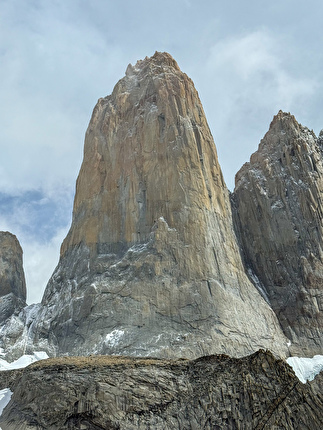
The South African route is 1200m long and climbs a series of striking corners straight up the East Face of the Central Tower. First ascended in a pure, bolt-free style by Paul Fatti, Roger Fuggle, Art McGarr, Mervyn Prior, Mike Scott and Richard Smithers during the season 1973/1974, the route was originally graded A4/5.10. It was first climbed free with difficulties estimated at 7b+/5.12c over a period of 13 days in 2009 by Sean Villanueva, Nico Favresse and Ben Ditto. On 13-14/02/2026 Tommy Caldwell and Siebe Vanhee completed a remarkable 24-hour free ascent of this famous big wall.
 See all photos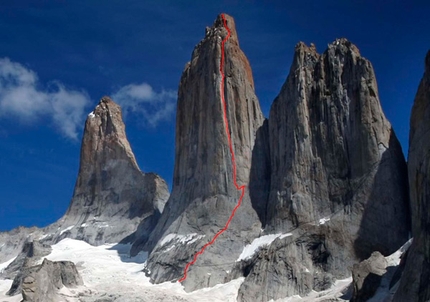
 7b+/5.12c