


 Stefano Ragazzo
Stefano Ragazzo is the Rider on the Storm in Patagonia

 Copia link
 1 / 7Stefano Ragazzo
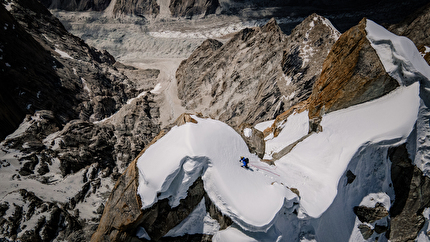
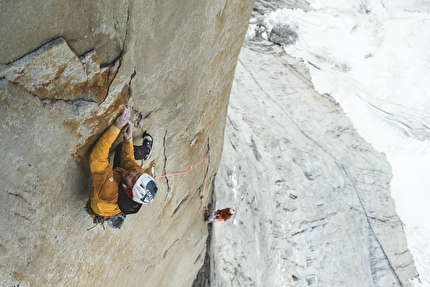
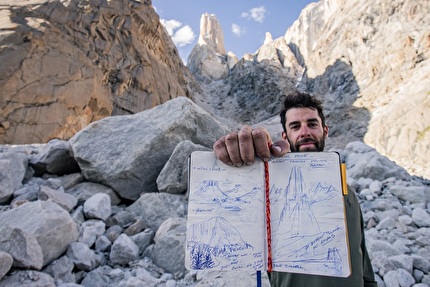
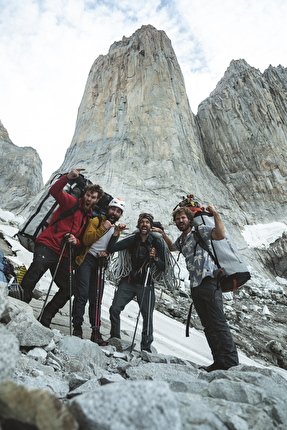
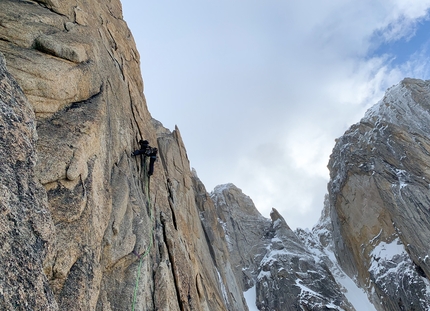
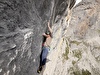
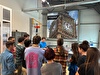
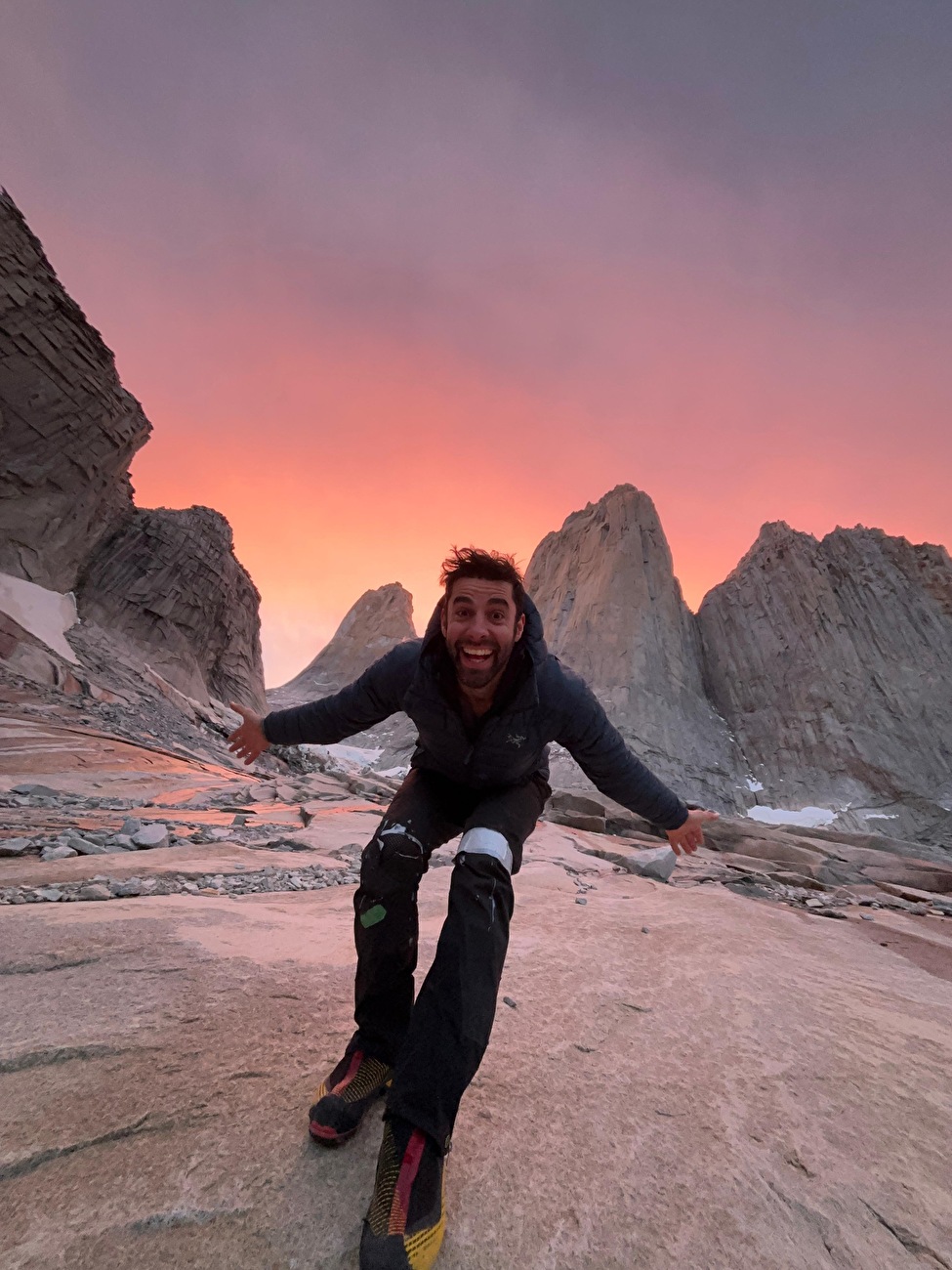
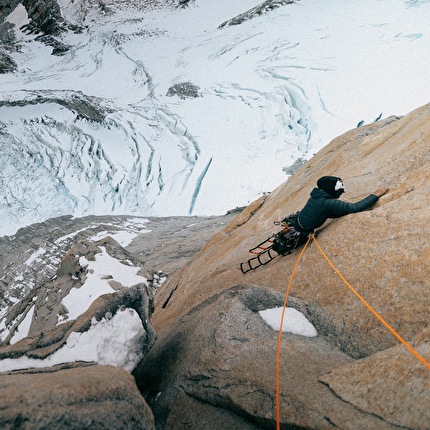
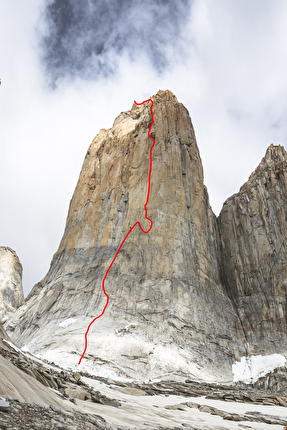
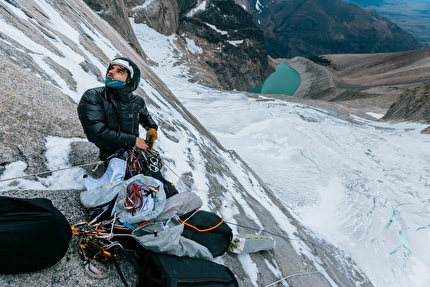
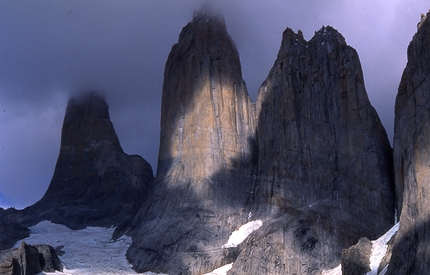
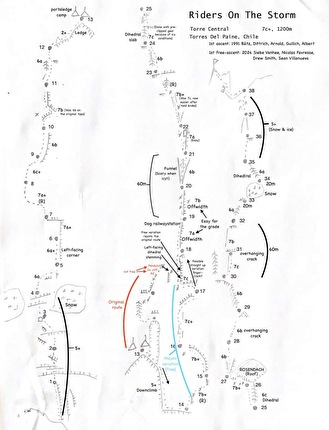
Stefano Ragazzo rope solo on Riders on the Storm, one of the most famous big walls in the world. This extraordinary news comes straight from Patagonia, where the 34-year-old Italian mountain guide has succeeded on the legendary route that ascends directly upo the east face of the Central Tower in the Torres del Paine massif. First climbed over six stormy weeks between late 1990 and early 1991 by Kurt Albert, Bernd Arnold, Norbert Bätz, Peter Dittrich and Wolfgang Güllich, this 1300m line is considered one of the crown jewels in Patagonia's repertoire of big wall climbs. At the time the Germans breached difficulties up to 7c free and A3 aid, and after numerous attempts by various expeditions, the coveted first free ascent was finally made in 2024 by Nico Favresse, Siebe Vanhee, Sean Villanueva O'Driscoll and Drew Smith. Now there's the first-ever rope solo ascent, in capsule style: after fixing the first 12 pitches, Ragazzo began his push on 21 Februar and returned to base on 7 March, having reached the summit at 12:40 pm the previous day. His success follows several other big wall rope solos, most notably the historic, first rope-solo of Eternal Flame on the Nameless Tower in the Trango Towers massif in 2024.
Stefano, nice one! Did you go to Patagonia just for this route, or was there something else on the cards?
No no, just this. Only for Riders.
Did you train specifically for it?
Yes, massively! In July I'd been in Pakistan with two American climbers, Michael Hutchins and Christopher Wright. Chris unfortunately got injured and the expedition didn't work out, but even before the accident I didn't feel comfortable, mentally or physically. I felt completely overtrained – I'd trained too hard and I was struggling to acclimatise. So when I got home I told myself: "OK, reset everything, start from scratch and find a goal that's entirely yours." I realised the time had come to do a sort of Eternal Flame 2.0.
So that "failure" acutally gave you some new motivation?
I'm always like that – when I get angry, when something pisses me off, I find the energy to turn things around and do something cool. A bit like when The North Face dropped me before Eternal Flame. So I started building. First thing, I changed coach. And then I got my head down and trained hard from the end of August until the 10th of January, when I left for Patagonia. I dedicated those six months to training every single day. I stopped working, I stopped doing anything else. Every morning and afternoon I trained.
And did it work?
Amazingly. Me and my coach talked it through to figure out what I really needed. Lots of cardio, obviously, and plenty of climbing and gym work. And loads of haulbag practice. I'd fix a rope on a route and go up and down with a rucksack filled with 10 kilos of water. Up and down on the jumar – I'd do 500-600 metres of jumaring every afternoon. Physically and mentally I felt prepared, and when I left I knew I'd done everything I needed to do beforehand.
Plus, out there – unlike the Trango – you don't have to acclimatise
Yes, that was pretty important mentally, because I felt I could recover much more quickly during the night. Especially at the beginning, when I was hauling the bags up and fixing the first pitches, I felt I recovered well overnight. But that was the only thing that was easier. Everything else was way harder.
Like what?
As soon as I made the first moves on the first pitch, I realised this was going to be an absolute nightmare. The lower pitches give you a taste of what's to come: easy grades on paper, but in reality rotten rock, unprotected slabs, lack of belays, difficult route finding. I was doing 60m pitches placing three micro nuts. It's easy to talk about it now, but when you're there, completely alone...
Did you know this beforehand?
Yes and no. I'd asked around a bit but unfortunately I had a hard time getting any precise information. I have to say Nico Favresse was great – he explained a huge amount and was incredibly kind. A top bloke.
What style did you want to adopt for the climb?
From the moment I arrived in Puerto Natales, the weather was always bad. Maybe there was a one-day window every week and a half, and I used those days to transport all the gear up and start fixing the first pitches. My initial idea was a fast ascent, a bit like I'd done on The Nose. But with that bad weather, and the fact I was slow – partly due to the difficulty of finding the right line – I convinced myself to try the route in capsule style. I slowly fixed the first twelve pitches, went back down to the ground and waited for at least two days of good weather before committing to the push.
12 pitches, then the push to the summit without ever returning to base, right? 12 pitches out of how many? Remind me.
40.
Well, that's quite a lot of unknowns...
I had dinner for 14 days, breakfast for 8 days, and food for 8 days of climbing. Plus, unlike Eternal Flame, I had to carry my own water. In total, I had about 60 kilos in the two haulbags.
How did it go?
I started on the 21st of February. I jugged the fixed lines and spent the first night in the portaledge, then after one day of bad weather there were two decent days, so I fixed up to below the big roof and returned to the portaledge. There I waited out a few days of bad weather, before spending a day moving the camp from the 12th pitch to below the roof. The weather remained uncertain but I managed to climb the famous roof, and did two or three pitches above, then a tremendous low pressure system arrived.
Was it cold?
Freezing. There was one day when the maximum was -7°C, the minimum was -9°C. All the water, all my stuff – everything was a block of ice. Insanely cold. One day I tried to climb in that cold, but I couldn't even move – I struggled just to jug the fixed ropes. Above the roof there are two hard pitches, then the terrain changes, becomes mixed. I told myself I had to hang in there, fix up to that point and then wait for good weather to try the push to the summit. So I spent a day climbing in the snow with my boots on. Pure aid, A2.
Was it windy?
Really windy. When I got back to the portaledge, this insane low pressure system arrived – I knew it was coming thanks to Silvia and Rolando Garibotti sending me weather updates. They'd both warned me about gusts exceeding 100 km/h.
Did you feel safe in the portaledge?
Not really. The day I did the roof pitch, while I was climbing a stone fell on the portaledge and tore a hole in the flysheet. A hole about the size of a hand. I tried to tape it up, but with the cold and ice the tape kept coming off. Tape, tape, tape – until this storm hit. The hole kept getting bigger and bigger, there were wind gusts so strong they were tossing me around everywhere, I was terrified, then all hell broke loose.
What do you mean?
The flysheet tore completely and acted like a sail, the portaledge flipped over and I found myself upside down, my legs tangled in the guylines, with everything falling out into the void. At that moment I told myself: "OK, this is it. I'm going to die."
Incredible
I've been doing this life for 15 years and I've pretty much seen it all, but I've always felt that somehow I'd get through things. Here, for the first time in my life, when the portaledge suddenly tore apart in the middle of that insane storm, I told myself I was screwed. At that instant I kind of paralysed – I thought there was nothing I could do. The thing is, all my ropes, all my gear, were fixed to the pitches above.
A nightmare
I had a 60m rope 'd used as a pillow, but a lot of the stuff inside the portaledge wasn't clipped to the webbing. Like my jacket that was under my head, the solar panel, the food, the food bag... it all fell out! From when the flysheet tore to when the portaledge flipped over was about 25 seconds, and in those 25 seconds I tried to stuff everything I could into my rucksack. I was inside my sleeping bag... I packed as much as I could – the stove, my gloves, a bag of energy bars, that's it. I had my boots in my hand, then the portaledge flipped and I found myself upside down with my boots in my hand and the wind slamming me from side to side.
Was it night?
No, it wasn't dark, it was about 7.30 in the evening, it was getting dark and there, for the first time, I swear, it was truly awful. I told myself: "No, fuck, I don't want to die here. But what the fuck can I do?" I considered pressing the SOS button on my Garmin, but then I thought about it for a moment and realised that waking Silvia or Rolo wouldn't change anything. No one could do anything here. I couldn't go up or down – imagine what someone at home could do? So I realised I had to get myself out of this mess on my own.
How?
Little by little, I tried to sort things out. I ripped off the flysheet because it kept flapping everywhere like a sail. I tried to put my boots on, I untangled my legs. At that moment the portaledge transformed into a wild horse, thrashing left and right – I was afraid of being hit on the head. I managed to fold it up and hold it still with my knees against the wall. I was on a smooth slab, no footholds, nothing. The only thing I had was that 60m rope, so I fixed it and abseiled with my Grigri for two pitches to a belay on a small ledge, about half a meter by a meter. I knew I had to try to get through the night there.
And?
I stayed hanging from the Grigri the whole time because the ledge was tiny and the wind so strong I couldn't even sit – it kept shifting me around. I spent the night with my hands above my head holding the sleeping bag closed, every now and then I'd doze off but then I'd feel my feet freezing – I kept trying to move them, banging them against the wall, until around 6.30, 7 in the morning things started to calm down. The sky cleared a bit, around ten o'clock the sun came out and warmed things up. I was completely soaked, among the things that had fallen down the mountain was my waterproof jacket. I was drenched, but my sleeping bag had saved me. Without it, I'd be dead.
So what did you do?
I was in contact with Silvia and Rolo, who were giving me weather updates. I decided to wait a while, dry off, then go back up and retrieve my gear so I could bail, leaving everything on the wall. At midday I went back up and tried to open the portaledge to sit down and eat something, because the evening before, when the storm hit, I hadn't had dinner yet. By then I hadn't eaten or drunk for almost 24 hours. I opened the portaledge – it was okay – and I lay down there, spent the afternoon resting, but then for the first time I felt the temperature rising. For weeks I'd seen these clouds racing, moving incredibly fast, and I remember I closed my eyes, opened them and the clouds were still. It was really strange. The good weather window was actually coming! I told myself: "You've been here for two months, you've been on the wall for two weeks now – go for it, dig deep for that last shred of strength and go for it."
And you set off for the summit?
I spent the night there on the portaledge without the flysheet, with my alarm set for 3 am, then I jugged back up the ropes and reached the end of the fixed lines at dawn. At 8 am the sun hit the face – it was stratospherically hot, it was insane to go from -10°C to +10°C in less than 24 hours. I started climbing the mixed pitches and, since I was moving fast, I ditched my rucksack and accelerated like crazy to climb the last 8 pitches. It had been cold in the previous days and the ice wasn't bad – I could climb fast with crampons and axes. When I reached the summit I thought it must be late afternoon, but actually it was only 12.40 pm. On top it was surreal – not a breath of wind, completely dead calm, blue sky, not a cloud.
A dream come true
Absolutely incredible. I relaxed for about twenty minutes, then began the epic descent – abandoning ropes, pegs, anchors behind. I abseiled all the way down to where I'd had my first camp at the 12th pitch around 10.30 pm. I ate something and the next day continued descending. I set foot on the ground, on the glacier, around 5 in the afternoon. It was over.
What a story, Stefano! Insane. But then was there a drop in adrenaline? Did exhaustion hit?
No, that was also incredible. By that point I had three haulbags – I'd left one at the base – three bags absolutely stuffed with gear. I started shuttling them.I'd do 100 metres with one, go back and get another, back and forth, weaving through crevasses on steep slopes. I kept this up for 3-4 hours, got everything off the glacier, then I sat down for a moment and at that point I crashed for half an hour. I was out of danger, I'd made it.
You'd given everything?
Yeah, this time I had to really push myself to the very limit. That said, I'm still surprised how good I felt as soon as I got off the mountain. People who saw me said I looked like an ant – back and forth, back and forth. That's training, that's all about having a solid foundation – I'm happy.
Two more questions, Stefano – I'm too curious: was the route as good as you expected? It's one of the most famous big walls in the world
Well, from a pure climbing perspective, in terms of the enjoyment of climbing, I'd hoped Riders would be better. Throughout the first part the rock is really poor, the protection is runout, it's very dangerous, lots of stuff falls from above, so you're constantly stressed by that situation. Then the central part, where the headwall is, the offwidths – it's cool and fun. I was happy I'd done the Monster Offwidth on El Cap because I was doing the exact same moves here. Then the upper part – again, not very nice. Whereas Eternal Flame is like climbing on El Cap, but at 6000 meters. The cracks are cool, lots of jamming, whereas on Riders I did loads of aiding, on skyhooks. I placed more peckers and precarious gear on Riders than in my whole life! At least, that was the impression I got, speaking as a pure climber. Eternal Flame is a much more beautiful route.
And if you compare the experience?
On Eternal I thought I'd given everything, dug in right to the bottom. Now that I've done Riders I can say I dug not twice, but three times deeper. Take away the altitude, everything was harder. The climbing, the aid, the feeling of making those moves on skyhooks, 15 metres up a rotten crack, with haulbags getting stuck, the monster offwidths while rope-soloing... it was all much, much more. On Eternal, if you fail, you hang off a good cam. Here, onyou're tenuously weighting a skyhook or a pecker. Not quite the same thing.
You played your joker!
No come on, I don't want to say I played my joker. I'd say I played my cards correctly, without the joker. I got myself out of trouble on my own. And I'm happy about that. For a minute I panicked and thought I was going to die, then in the middle of that storm I managed to reset everything, little by little I started figuring out what to do. It was like when you have a 1000-piece puzzle, all mixed up – it seems impossible, then you start putting some order into it, moving the blue pieces over there, the red ones over here, until you finish it. Up on the Central Tower was more or less like that. 15 years ago I wouldn't have managed to get through it. My experience, the positive and negative experiences of the last 15 years, allowed me to complete Riders rope-solo.
Well, congratulations Stefano, you really created this success for yourself, you deserve it!
Stefano thanks: Grivel, La Sportiva, Totem Cams
 See all photos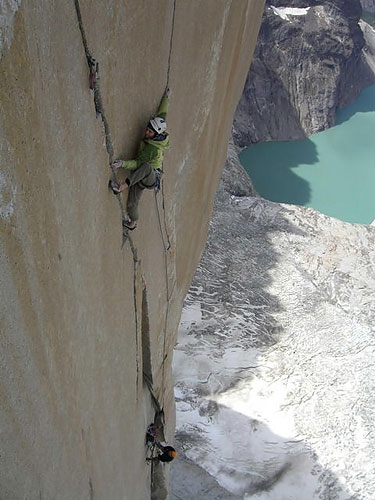
 7c+
7c+