


 archivio Silvestro Franchini
The route that doesn't exist on Cima Brenta by Silvestro and Tomas Franchini

 Copia link
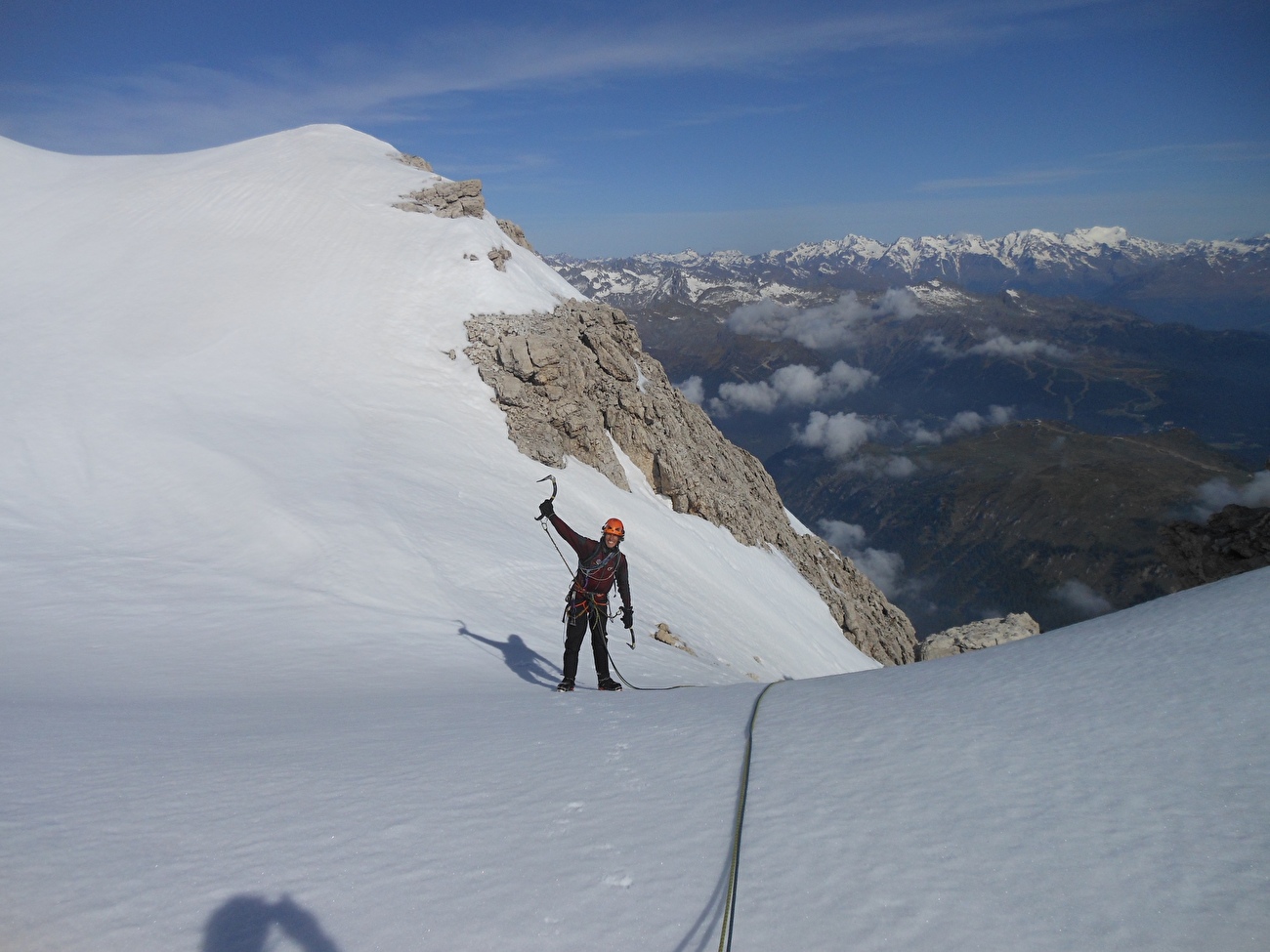
 1 / 21archivio Silvestro Franchini
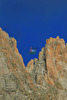
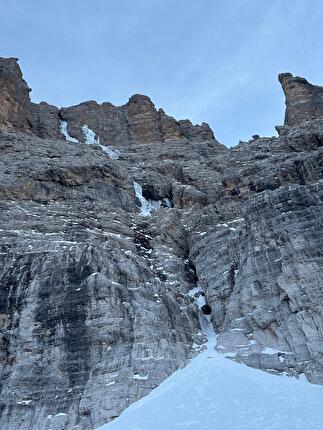
I've been asked to talk about La via che non c'è (The Route That Doesn't Exist) and I'm very happy to do so, because it's located right above my home and because I opened it with my brother Tomas, on the 2nd of June 2012. Friends who repeat it send me nice messages, and on Facebook and Instagram I see many photos; the route effectively attracts climbers not only from our area but from all over Europe. It's quite famous even in Germany, where it's been called Der Weg, den es nicht gibt.
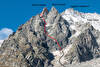
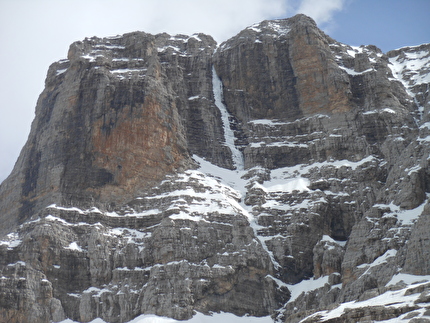
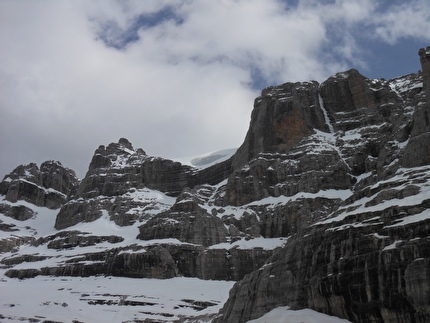
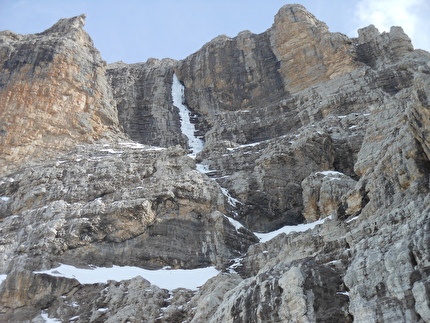
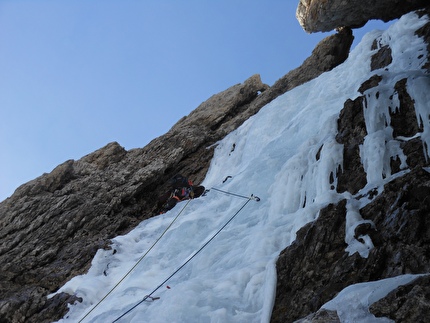
But let's get to the story of the first ascent. It's spring 2012, we're already begun climbing on rock in the Brenta Dolomites, and on the 29th of May we are on Corna Rossa, climbing the Donato Zeni route opened by Cesare Maestri. It's the first time we're climbing it (later I'd return with Manuel Bontempelli for the first free ascent), and from the summit, the view opens up onto Cima Brenta. We notice an ice drip that seems almost unreal. We immediately organise to climb it: finding a partner isn't a problem for us, nor is packing our rucksacks, since we share all our gear. These are the last years we still live together in our parents' house.
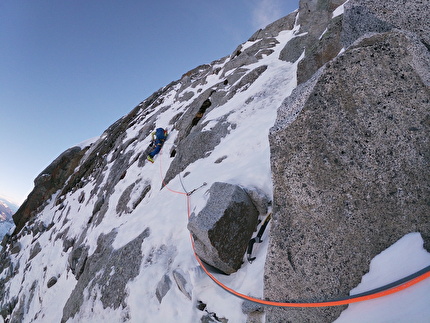
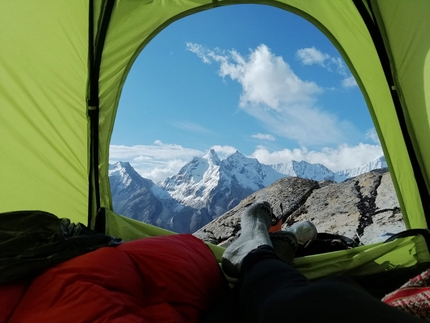
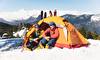
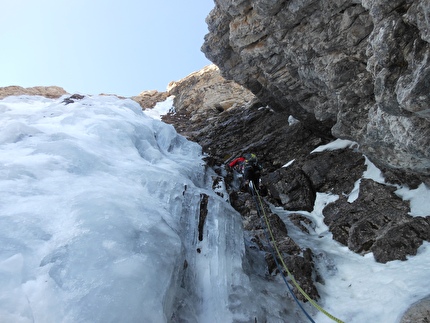
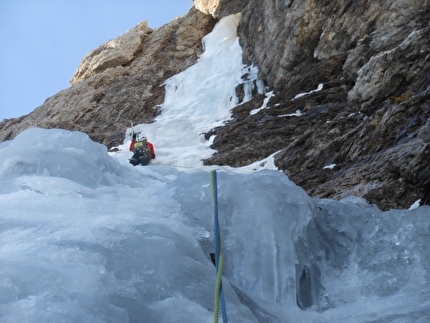
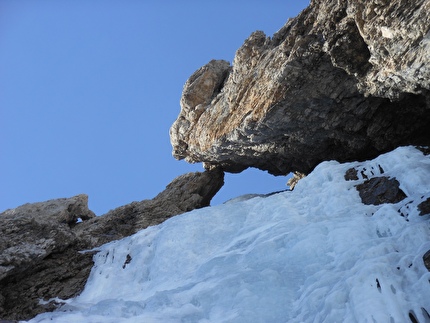
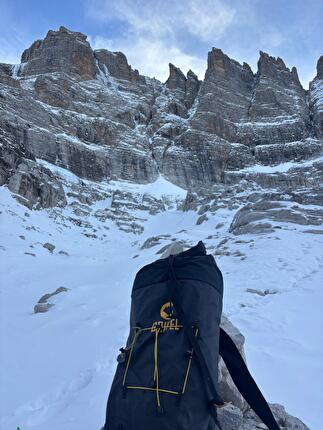
On the 1st of June, we pack our bags; Tomas goes up to sleep in the winter room at the Tuckett refuge — he always liked shouldering his pack and sleeping out overnight — while I prefer, if I can and have the energy, to start from the valley. On the morning of the 2nd, we meet up at the hut and set off for the climb. While approaching the wall we notice that the upper part is well formed, but in order to reach it we have to overcome a horizontal band of rock. There are a few unknowns: the ice is white as milk and looking at it doesn't inspire much confidence. Will it hold our weight?
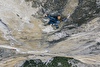
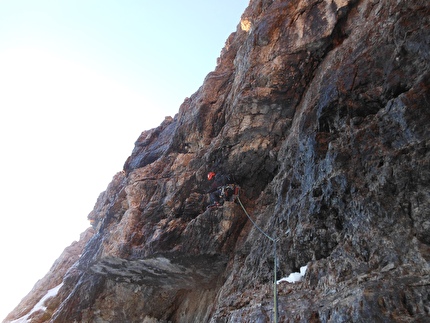
It holds. The fourth pitch, where a small drip now forms, is entirely on rock. I remember Tomas traversing across the cave where the belay is now located. On the upper part, I imagine being on Cerro Torre: in a few months time, we'll have our first trip to the Greater Ranges, destination Patagonia. After this climb, we'd be even more prepared. We don't abandon any gear, and at the exit of the route, we descend the Massari gully without going to the summit — something we never gave much importance to. What always interested us was the route itself; the summit was optional. It always came naturally to us that way.
After our ascent a few years pass and, as we predicted, the route no longer formed. Usually, the serac icefall on Cima Brenta forms well, but now it's always a bit dry. I still get chills when I think about the time I climbed it without a rope in poor conditions — in the past, retreat wasn't a valid option for me...
But in recent years, something has changed up there, and almost every autumn, La via che non c'è reappears. Tomas even climbs it without a rope, and to our great joy, some friends begin repeating it. Word spreads, and it becomes increasingly coveted. The route that doesn't exist does exist, and how.
This year, the walls here in the Brenta are quite dry, but at the start of the season, I want to take a closer look and, under the pretext of doing some training, I climb to the base of the route. I realise it's in excellent condition. Since I expect it will see many repeats this season, as many of my colleagues do, I plan to go up and fix the abseil anchors; now we're used to always finding bolts on abseil, and if they're not there, it feels like something's missing. I reflect on this: safety has now become almost an obsession for me, especially when I'm guiding clients. After discussing with some colleagues, I form an idea: bolts take something away, they don't add. Mountain guides and alpinists must not unlearn how to use pegs and lose trust in the anchors that nature offers us. In the end, nothing needs to be added.
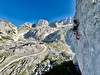
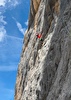
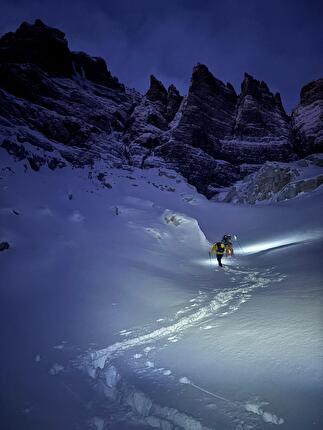
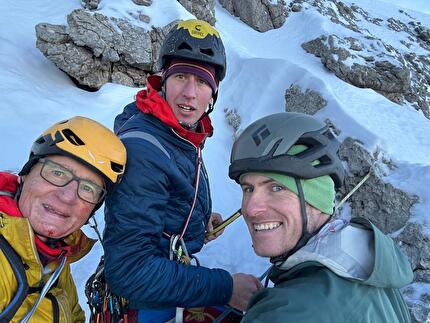
I agree with Emanuele Andreozzi to go on a reconnaissance trip, and then my friend Claus also calls me; we've been planning a climb together on this route for a long time. We wait for a day after the snowfall; in the meantime, I go up again after work, just to be sure my colleagues don't have to work too hard, carrying up some gear and water. On the 19th of December, we make our way to Rifugio Tuckett; December 20 is my mother's birthday, but with Claus and Emanuele, we start up the route.
I'm very motivated for this climb; it will evoke memories. I'm aware that this repeat will pave the way for other climbers, giving other people the chance to enjoy themselves on these walls. I hope that many, passing by here, will think of my brother, who perished in 2024 on Mount Cashan in Peru. Perhaps this will bring him back to life a little. That would make me happy.
Breaking trail and climbing first, as you well know, is completely different from having the hard-packed track and placements in the ice. Two strong guys from Arco made an attempt earlier but stopped two pitches from the end; after the recent snowfall, their footsteps were covered, but we still noticed their passage when we found the Abalakov they abseiled off. Nice one.
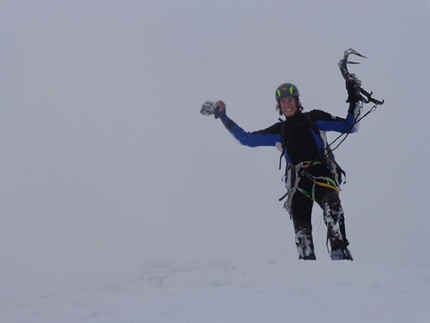
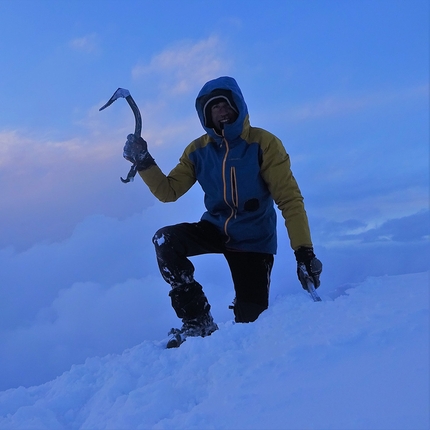
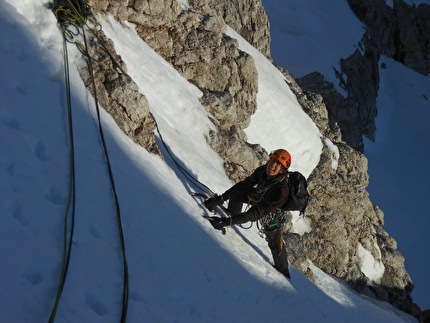
The very next day, the route was repeated by my friends and strong climbers Mirko Corn and Luca Caldini. High pressure arrived, and as I predicted, throughout the Christmas holidays and until the 20th of January, someone repeated the route every day. This year, more than ever, you see rucksack brimming with ropes and ice axes, and strange characters biking into Vallesinella. And rightly so.
The route is beautiful, magical, neither too easy nor too difficult, neither too long nor too short. The Brenta Dolomites are always magical, and I don't say that because they're my home, but because they truly are.
Silvestro Franchini, Madonna di Campiglio
 See all photos