

 Vladek Zumr
On Cerro Walwalün in Chile's Cochamó Valley Mirco Grasso & Jernej Kruder establish the big wall Tarock

 Copia link
 1 / 16Vladek Zumr
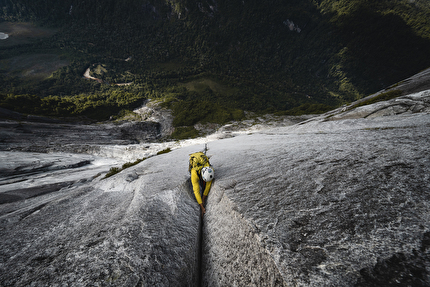
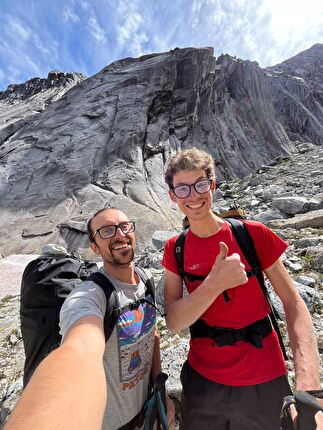
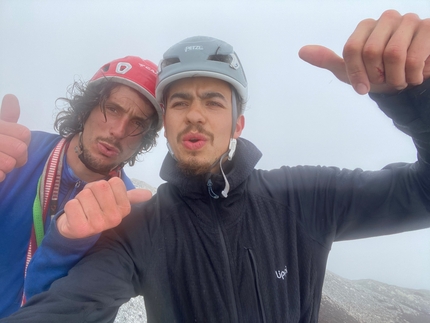
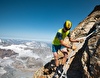
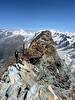
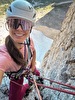
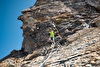
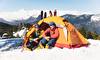
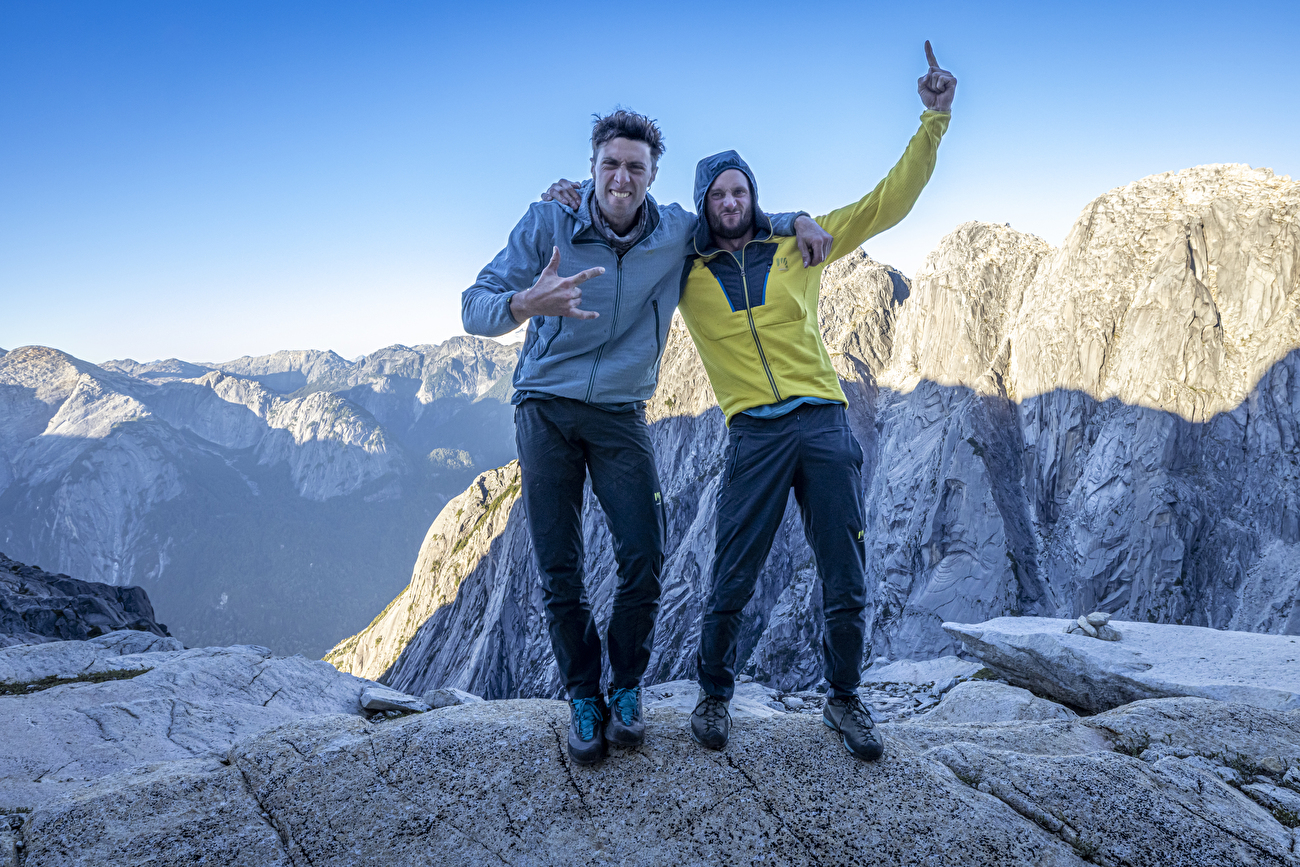
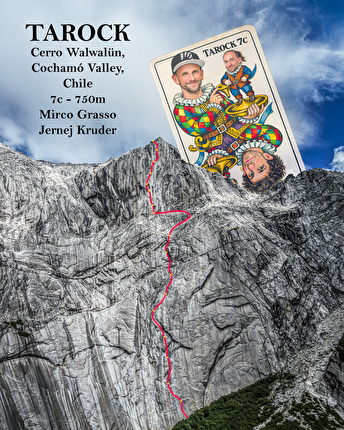
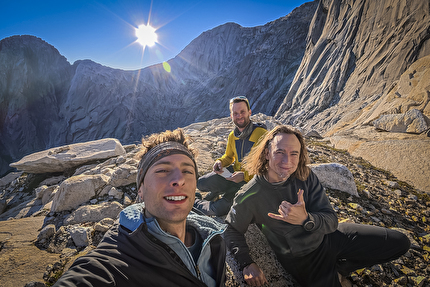
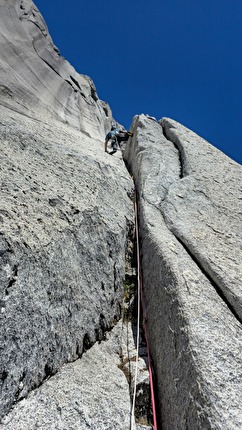
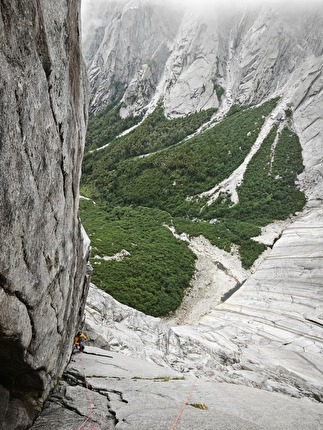
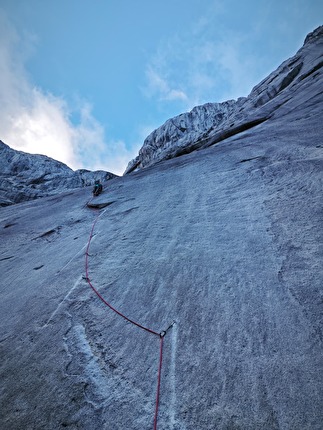
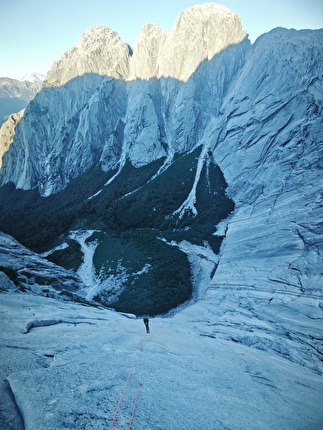
Italy's Mirco Grasso and Slovenia's Jernej Kruder have just spent three weeks in the Cochamó Valley in Chile establishing a new free climb on Cerro Walwalün. Called Tarock, the 750m big wall breaches difficulties up to 7c and tackles a line up smooth slabs and soaring corners of the mountain's northeast face. The pair were supported by Czech photographer and filmmaker Vladek Zumr.
The idea first surfaced last December, when Kruder floated the idea of an expedition to Chilean Patagonia. Grasso had another trip in mind, but that fell through due to political instability in the host country.
"I don't even remember where I was when Jernej called. I just know I said yes almost immediately. We didn't have a specific objective - just a massive valley in front of us and the desire to take things as they come," Grasso recalls.
Cochamó is by now a legendary destination for climbers and trekkers alike, but it still retains an exploratory edge: sketchy information, hand-drawn topos, approaches that resist easy documentation. It's a place that rewards those willing to get a little lost.
The team arrived at the start of the new year and set up basecamp at La Junta, the campsite in the center of the valley, reached after driving for two hours from Puerto Montt followed by a three-hour hike. After an initial attempt to open a route elsewhere, aborted when they discovered bolts on their intended line, and a repeat of the demanding Entre Cristales y Cóndores on Atardecer, Grasso and Kruder spotted an obvious line on the northeast face of Walwalün, arguably the most imposing peak in the amphitheater area. When conditions finally aligned, they went for it. The opening took three days, followed by another three dedicated to freeing every pitch.
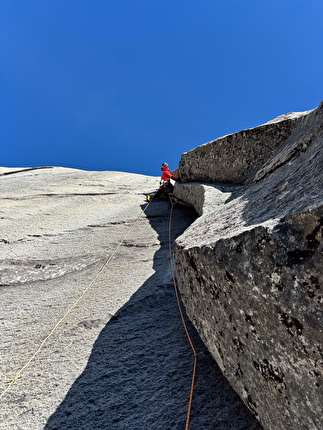
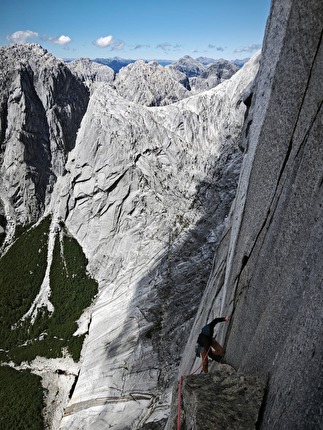
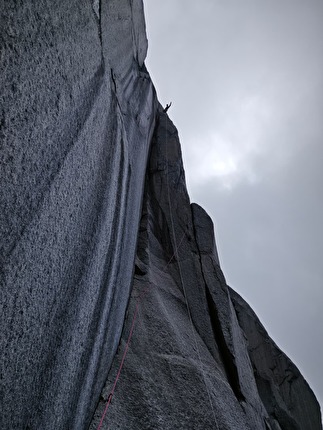
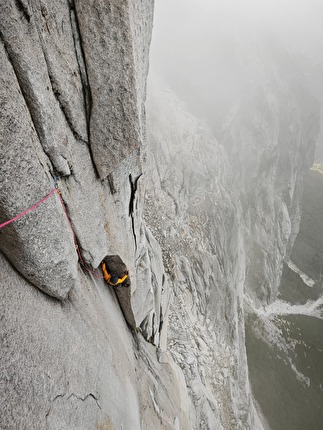
The route is split into two distinct sections: the first part (up to the large mid-height ledge), climbs smooth, technical slabs and runout pro; the second part follows extraordinary cracks and corners, sustained and beautiful on exceptionally compact granite. "The upper part is pure joy: incredible cracks, always climbable, never trivial. Every pitch had character. It was one of those moments when you realise you're putting up something special."
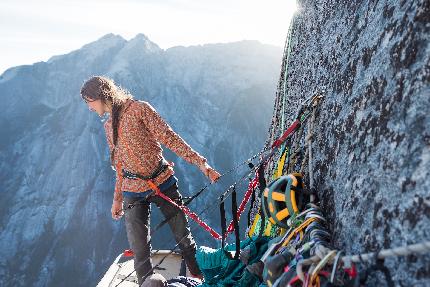
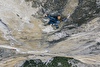
"We had no idea if the upper part had ever been climbed, or if anyone had been there before. Every pitch was a discovery. When we finally reached the summit ridge and hugged each other, with the drone hovering overhead and Vladek controlling it from the ledge, it felt almost surreal."
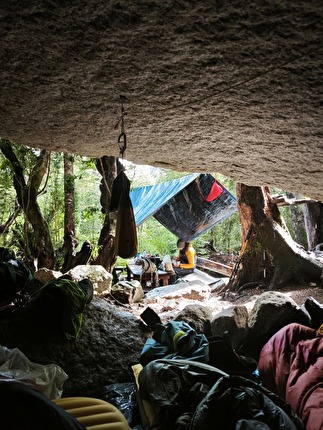
The name Tarock came from the long, rainy days at camp, when the team passed the time playing the traditional Austrian-Slovenian card game Kruder had taught them. An ironic name for a line that's anything but light. After more rain, snow up high, and seeping walls, the pair returned to redpoint the remaining pitches. The last one was the crux.
"We knew it would be the final test. It was dirty, wet at the top. Jernej went for it with determination and a few liberating shouts. When he clipped the anchor clean, we knew it was done."
"Maybe the best part wasn't the summit. It was the moment afterwards, lying on the garage floor at the end of the trip, talking about how well our team had clicked. With our hearts wide open. That's what makes these trips worth it."
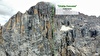
Tarock is located to the left of Perdidos en el Mundo, opened in 2013 by Lorenzo Lanfranchi, Mirko Masè, Simone Pedeferri, Mattia Tisi and Andrea Zaffaroni, and to the right of the wall's first route, 100 años de soledad, put up in 2001 by a French expedition. It encounters the French route at the large mid-height ledge where the original route veers right, and shares about 5 meters with the Italian route above the ledge before independently climbing a system of cracks to the left.
After the first ascent, the lower half of the route was freed on 12 and 13 February. Grasso and Kruder sat out another day of rain, and then zipped back up to the central ledge on 15 February via the French route, in order to free the upper section. Notably, during the first ascent, the second pitch above the ledge initially followed a crack that proved both extremely difficult and persistently wet. The pair opted to establish a slightly easier variant; the original pitch is estimated at around 8b and has yet to go free.
In total, Grasso and Kruder used 29 bolts (18 placed with a drill, 11 by hand), including those at the belays, about 15 pegs along the pitches and at the belays, and made extensive use of trad gear (cams and offsets). Some bolts were added on the descent to reinforce the anchors.
Mirco Grasso thanks: Karpos, Wild Country, HDdry and Scarpa
Kruder thanks: Karpos, Scarpa e Illusion
Both thank Diego Diaz Aguilera for his help and friendship
 See all photos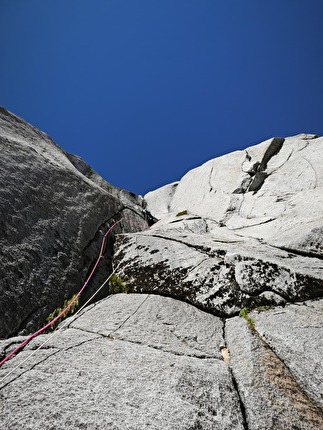

 7c
7c