


 archivio Francesco Vascellari
Cima Collalto, probable first ski descent in Dolomites

 Copia link
 1 / 6archivio Francesco Vascellari
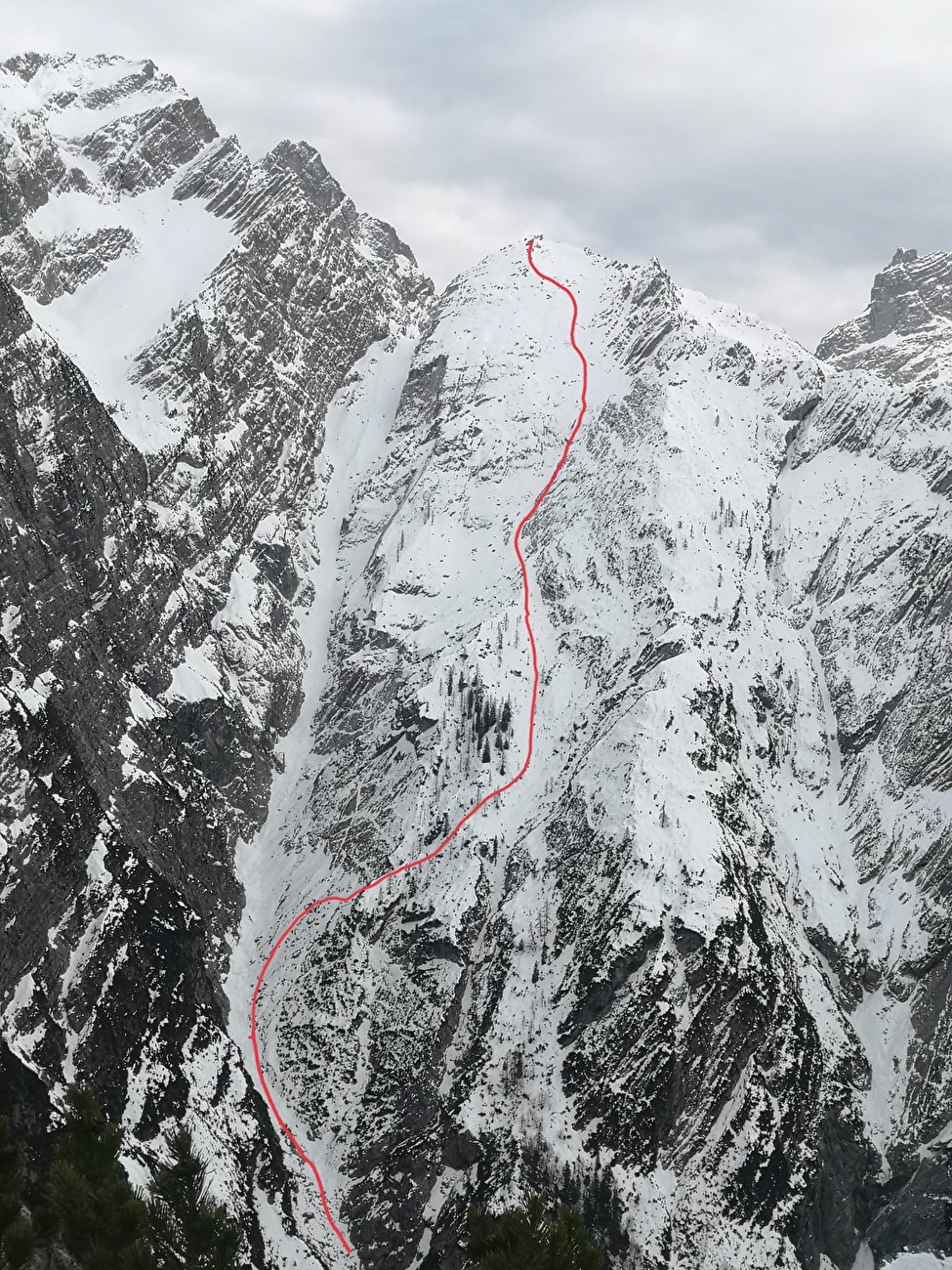
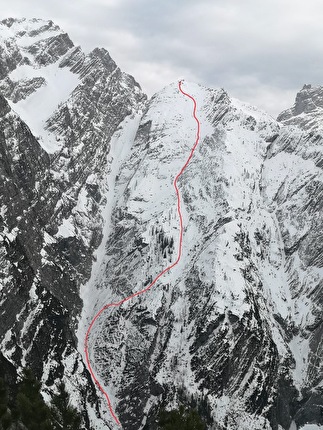
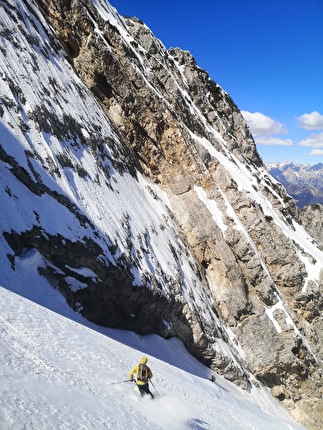
In 2026, in the now heavily developed Dolomites, there still exists a north face nearly a thousand meters tall that has almost certainly never been skied. It is steep but regular, not extreme, with a logical line, no rappel stations, no connecting ledges, and no prohibitive slopes. Yet it remains virtually unknown to most.
Such a claim would provoke skepticism in anyone. But by the end of this text, an explanation will emerge—one that can be summed up like this: when you truly seek the unknown, it hides in the folds of places very close to home.
Only a rare few who cherish these remote lands know this well. Among them are Michael Tramontin (who, with De Martin, reached the summit from another side using crampons and ice axe), Luca Vallata (author, with Cassol and De Menech, of an austere route on nearby Cima Gea), and a handful of other faithful devotees of these solitary peaks.
For years, Cima di Collalto remained a mere notation in my notebook, filed among modest adventures close to home. The project excited my longtime friends—especially Tiziano Canal, a true lover of wild terrain; Davide D'Alpaos; and also the "old lion" who is no longer with us, the good Loris De Barba. To him we also dedicated this journey.
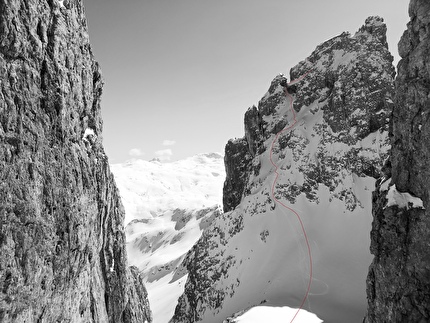
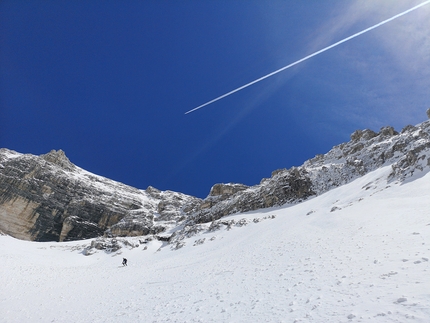
The north face of Cima di Collalto—a logical couloir of nearly a thousand meters—remains as hidden as few other great Dolomite faces.
In the panorama of Dolomite mountaineering, a parallel might be drawn with the Burèl and its remote face in Val de Piero, though there the access to the climb is more direct and obvious.
To observe this face and catch its fleeting snow conditions, you must reach the rare viewpoints: Monte Piziè, the Porte di Gea, or, farther away, Cima Laste—all of which are already harsh itineraries, even more so when covered in snow. So it is fair to say that there is hardly a skiable face in the Dolomites as vast and yet as secret as this one.
The reasons for its secrecy go beyond its sheer invisibility. It belongs to the most marginal and wild part of the Dolomites, the Oltre Piave. Its starting elevation is already hilly (about 500 meters), and the dense forest discourages any determined approach. Add to that increasingly intermittent snowfall, the difficulty of reading the line, and the ambiguity of passages between rock bastions—which only in hindsight reveal skiable couloirs.
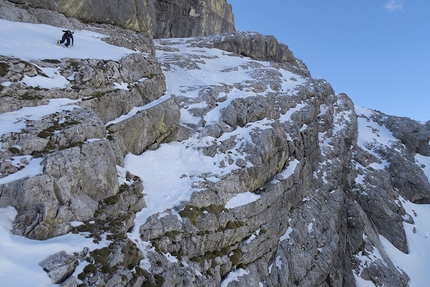
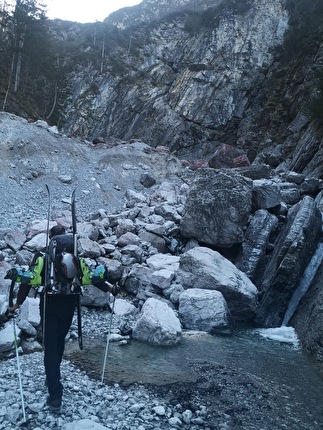
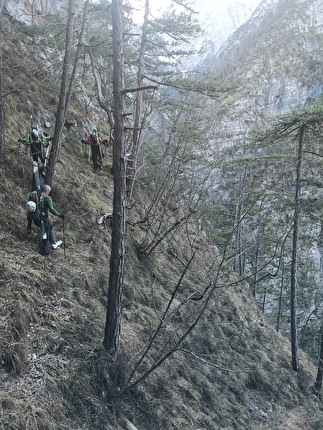
But the decisive element of the mystery is something else: the complete lack of a proper trail. Even just figuring out how to reach the base with skis and gear is a task reserved for those with nimble feet, accustomed to the wild: suspended passages, tangled vegetation, and broken trails.
Reaching it means following something like a viàz—a path of chamois and hunters—that takes, in the best case, over three hours: a long warm-up of body, attention, and determination.
Then, step by step, following the photograph from the last reconnaissance, the curtain opens on a logical line: steep but never extreme, continuous, deeply Dolomitic. Almost a small, wild fairy tale that — once past the hard shell of difficult access — reveals itself as a discreet pearl.
— Francesco Vascellari, Belluno
 See all photos