


 Ramona Waldner
Successful women's SAC Expedition establishes new climbs in Greenland

 Copia link
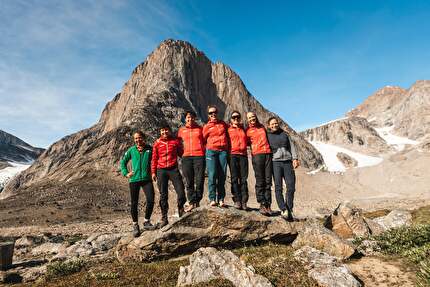
 1 / 62Ramona Waldner
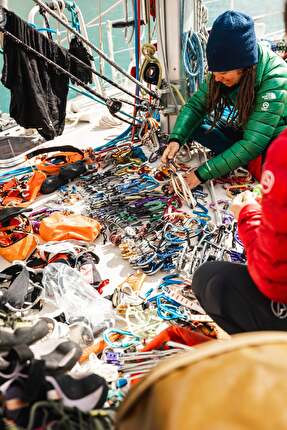
With a substantial amount of luggage (approx. 360 kg), we set off from the Basel railway station in Switzerland on the 20th of July 2025. As there is no overnight train for this day, we spend the journey in seated compartments. The train conductors are extremely friendly and don't mind us sleeping scattered on the floor in the carriage. After a more or less restful night, we arrive in Hamburg, where we stock up on food for the next few days. For a moment, we think we are going to be stranded at the bus station because the bus company refuses to transport us due to the amount of luggage we have. After an explanatory conversation and a re-check of our reservation, we are allowed to board. Off we go to Denmark, where we take the ferry from Hirtshals to Iceland on the 22nd of July. We spend the next 50 hours on the ferry reading, planning, training and sleeping. Once we arrive in Iceland, we drive our rental cars from east to west, stopping along the way to see the sights and Iceland's incredible nature.
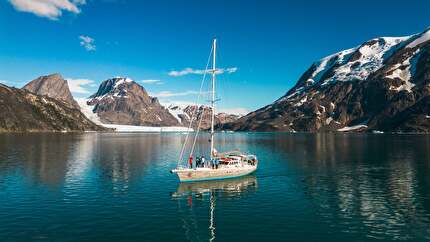
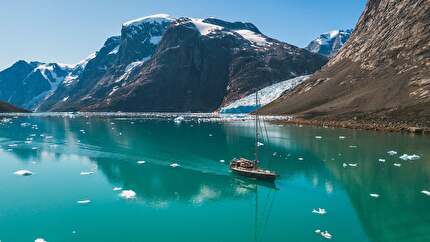
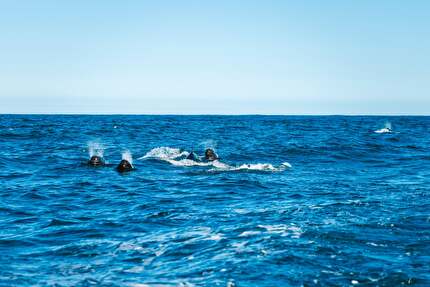
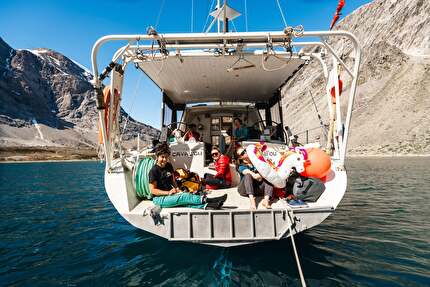
In Reykjavik, we meet our skipper Vicente. After a brief tour of our home for the next five weeks, part of the team loads the boat, while the rest does the shopping. On the morning of the 27th of July, we leave Reykjavik harbour on the Caval'ou, heading west for the four-day crossing to Greenland. We spend most of the time sleeping, sometimes eating, and at night in the wheelhouse monitoring the wind, boat speed and activities on the radar. After heavy swells in the second half of the day and the first cases of seasickness, the ocean calms down during the night. The midnight sun reflects in the smooth water surface, changing from golden yellow to orange to fiery red. The water seems to envelop the whole world like an impenetrable glass shell. Rarely have we seen anything so peaceful. On the second day, our sense of balance is put to the test once again. The waves are strong, water lashes overboard. There is no midnight sun, the sky is cloudy and we experience the opposite extreme to the first night, with what is probably the wildest sea we have ever experienced. On the third and fourth days, the sea calms down. The sun reappears and we watch the steady yet uneven movements of the sea. We observe the seagulls playing with the waves. And suddenly, still faintly visible on the horizon, land comes into view. We are now navigating by motor, as the first icebergs are appearing. Their size is difficult to grasp, as they exceed the size of our ship many times over. Accompanied by globis (globicephales are pilot whales that are slightly larger than dolphins), we sail towards the mainland.
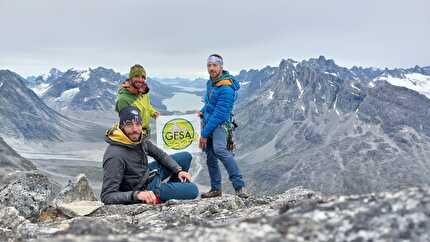
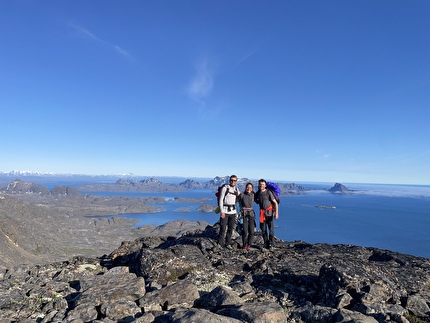
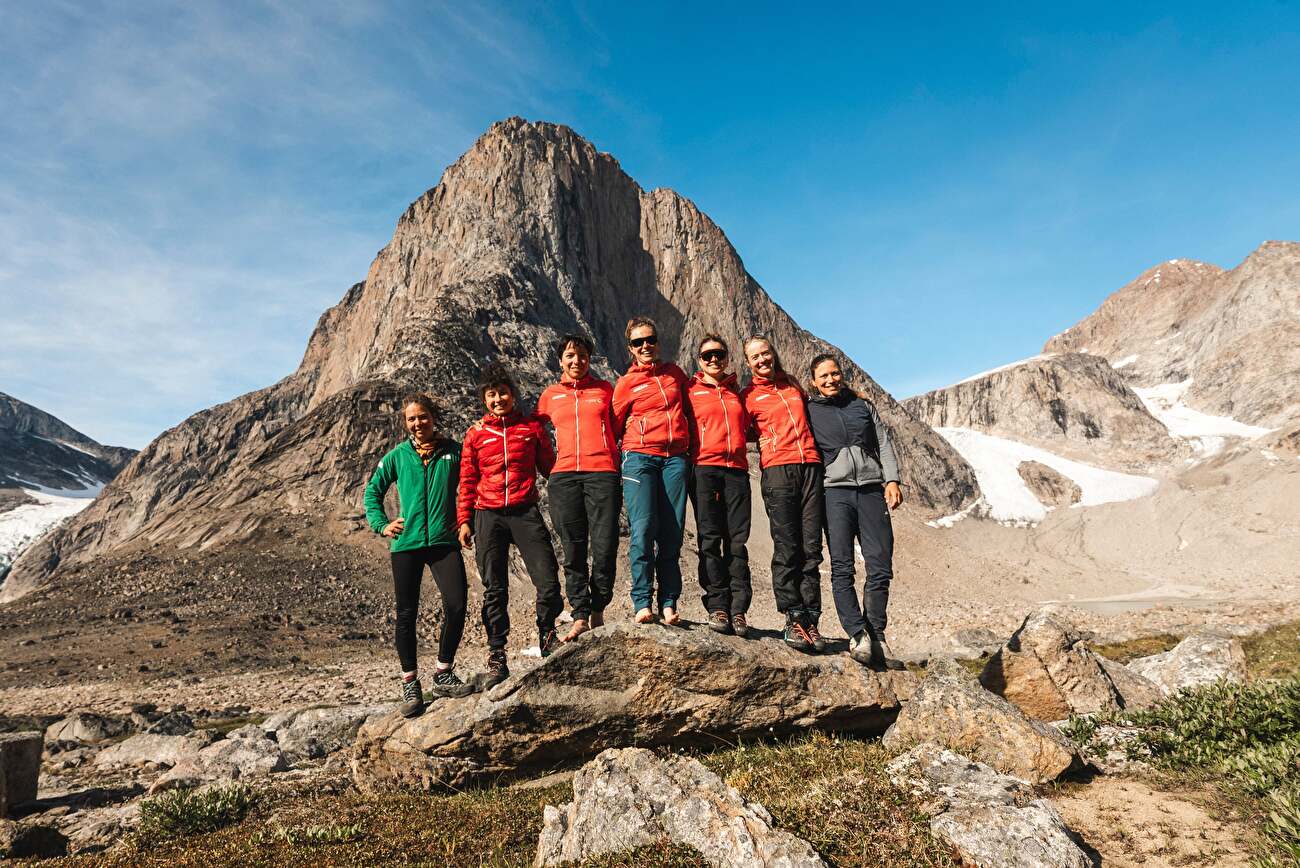
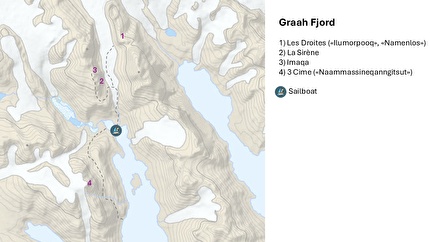
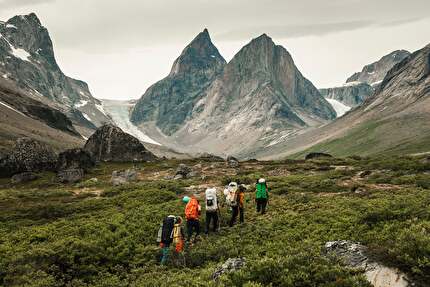
On the 30th of July, we set foot on Greenland for the first time. Movement, finally no more nausea, and rock beneath our fingers for the first time, even if just during a short hike. It feels good to find some peace again and hear the soft rustling of the wind in the bay where our boat was anchored. The land radiates a truly enchanting energy. The following day, we reach Graah Fjord (63.5193473, -41.4944041). At its end, the fjord's tongue splits into two valleys. We are in one of the most beautiful places we've ever seen: a small beach with several crystal-clear streams, fine sand, soft moss, wild glaciers, and high rock walls in the background. We observe the common mergansers. We admire the vibrant green cushion plants. The wind blows across our faces. We listen to the babbling of the stream. As the weather is forecast to be stable for the next three days, we explore the right-hand valley on 1 August. We climb over the moraine and the partially melted glacier tongue to get a closer look at the 400-800 meter high walls we had spotted upon entering the fjord. During this reconnaissance, we discover several potential lines for first ascents.
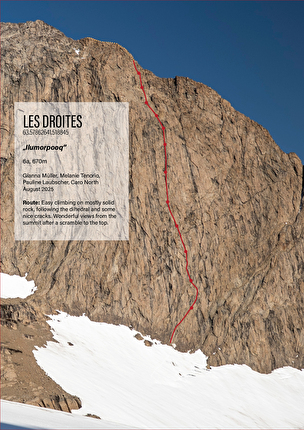
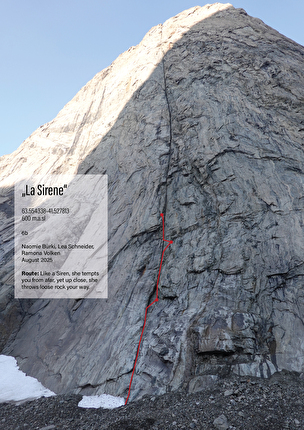
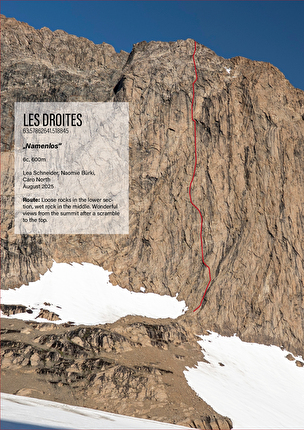
Caro, Gianna, Melanie and Pauline attempted "Les Droites," a 400-meter, west-facing triple-headed peak, while Lea, Naomie, and Ramona inspected the obvious dike line ("La Sirène") on a roughly 600-meter high, east-facing wall at the valley's entrance. The latter proves extremely loose, so the team retreats after 150 meters. The team on "Les Droites" fixes 320 meters of rope on the first day and returns to the boat in the middle of the night, uses the next day as a rest day, and returns to the wall on the third day. On this first day of climbing, we could finally experience again what we live for. Not for the climbing itself, as climbing can also be awful. But for that feeling that briefly surfaced that day: just the rock, the beautiful moves, and living in the moment.
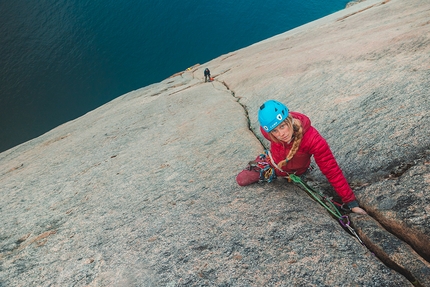
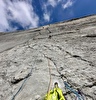
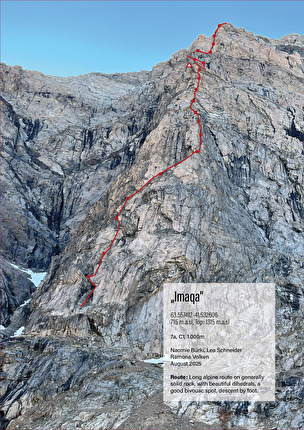
Lea, Naomie, and Ramona set off the day after retreating from "La Sirène" to attempt a line where several crack systems were to be linked. The line is located on a 600-meter , southeast-facing wall. Equipped with light bivouac gear, they set off. Between 11 PM and midnight, the final pitch to reach the intended bivy site naturally turnss out to be the day's hardest — about 7a, overhanging, and of mediocre rock quality. The motto to get up it is: "You must be a winner, otherwise there's no bivy site." After a particularly strenuous haul because the rope got stuck in a crack (yes, otherwise life would be too easy), Lea, Naomie, and Ramona fall asleep 400 meters above the ground, accompanied by the silence and the stars of the land of icebergs.
On the 4th of August, our two teams stand on their respective summits almost simultaneously. While "Les Droites" ("Ilumorpooq," 6a, 670m) requires abseiling, the team of three hiked back to the boat in three hours, achieving a completely "clean" first ascent ("Imaqa," 7a, C1, 1000 m). Completely exhausted and happy, the teams return to the boat, where Vicente greets us with a delicious and abundant dinner.
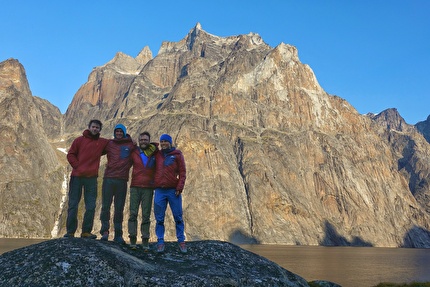
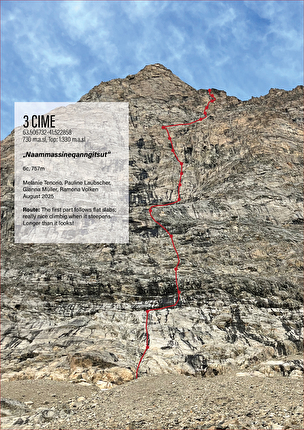
On the 6th of August, the game started anew, and the teams again scouted possible lines. While Caro, Lea, and Naomie inspected the headwall, a 300-meter high, south-facing wall in the same valley, the other four explore the three peaks towering directly above where the boat is anchored. According to the weather forecast, a beautiful day, a windy day, and then a rainy day are expected. As the Headwall requires a longer weather window, this project is abandoned and Caro, Lea, and Naomie spontaneously decide on a long day tour to make a second first ascent on "Les Droites" and rappel down the existing descent line (Unnamed, 6c, 600m). Gianna, Melanie, Pauline, and Ramona set out to make a first ascent on the first tower of the "3 Cime," a 600-meter high, east-facing wall. That night, they sleep tightly huddled together in pairs in a sleeping bag in their bivouac. The wind whistles incessantly around them, tugging at fabric and ropes as they try to find some rest. It is cold and uncomfortable, but in the closeness, a quiet sense of security emerges, carrying them through the darkness. After a restless night due to strong winds with gusts up to 70 km/h, the team decide to retreat ("Naammassineqanngitsut," 6c, 757m).
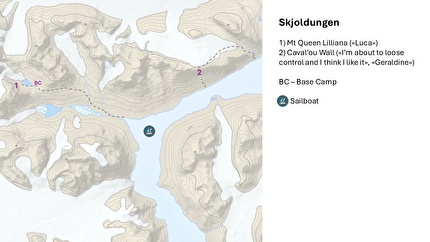
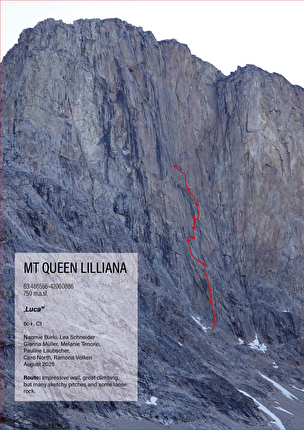
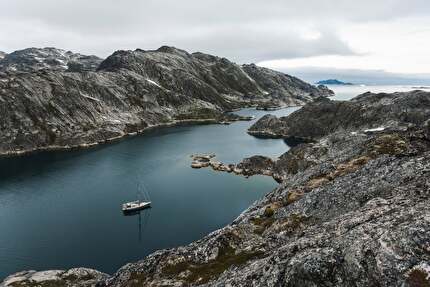
As the Skjoldungen Fjord (63.4588325, -41.8979090) was the original objective of the expedition, we change fjords after these successful first ascents. The 600-meter northeast face of Mt. Queen Lilliana immediately catches our eye. We had looked at pictures of it during our preparations in Switzerland. Due to the length of the approach (6 km, +400 vertical gain), we decide to establish a base camp on land (63.4849169, -42.0415831).
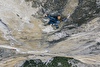
On the 12th of August, part of the team set up base camp, which is visited that same evening by curious arctic foxes for the first time. The project is intended to be tackled by the entire team in big-wall style. Caro, Gianna, and Lea start off, climbing and fixing four pitches on the first day. The rock quality varies from very compact to dangerously loose. On the second day, Melanie, Naomie, Pauline, and Ramona take over. They climb and fix five more pitches. The rock quality is still poor, and from this point, it is unclear if there is even a line leading to the planned crack system. On the third day, Caro and Lea return to the wall. The rest of the team carries food and gear from the ship to the base camp. The pair fix two more pitches of mediocre rock. The line is working, and the rock above finally seems to become more compact. With this very positive news, they descend euphorically to base camp. The next day, Caro and Naomie return to the wall with the goal of reaching compact rock and spending the first night on the wall. Unfortunately, the rock quality does not improve however. Due to this and because rockfall occurred on three of the four days climbing, we decide to abort the project and retreat. In total, we fix 460 meters of rope, thus climbing about half of the wall ("Luca," 6c, 460 m). The project demands a lot from us, and the decision to retreat is not easy. The team spirit, mutual understanding, a pinch of humor, and another visit from the cute arctic foxes at base camp help us process the retreat and plan our final projects with renewed courage.
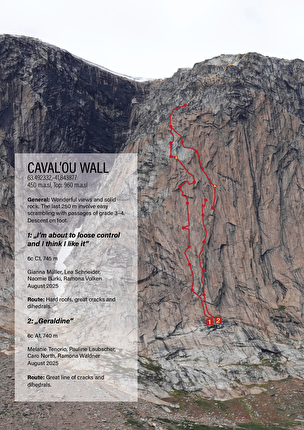
After several rest days at base camp and on the boat, we have our eyes set on two more lines. The weather is forecast to be stable for the next three days. After scouting the wall, on the 20th of August two teams of four, this time including the camera operator, set off on the southeast-facing Caval’ou Wall, located to the left of the Discovery Wall. The teams are rewarded with enjoyable climbing on bombastically compact rock and achiev two first ascents. One of them is completely "clean" ("I’m about to lose control and I think I like it," 6c C1, 74 m), while the other, due to a discontinuous crack system, has one abseil station and required a peg at another ledge. We descend on foot, and back at the sailboat, Vicente awaits us, as always, with a delicious dinner.
For the first time in three weeks, the weather deteriorates significantly. Grey clouds and rain roll in. Skjoldungen sinks into a grey soup. We use the days to rest, explore the fjord further and reflect on the expedition. On our last evening in Greenland, we lie on our Z-Lite pads on the deck of the sailing boat. The silence of the night surrounds us. Below us, the sea glitters, and with every gentle movement of the water, fluorescent plankton awakens, shining like stars in the depths. Above us, the Aurora Borealis (Northern Lights) dance – green and violet veils silently sweeping across the sky. In this moment, time seems to stand still, and it feels as if the world is giving us one final, glowing promise: that the magic we have created together in these wonderful
fjords of Greenland will live on in us forever.
With a wealth of memories in our hearts (at least 360 kg worth), we set sail on the morning of the 26th of August and head east — back home.
Naomie Bürki, Switzerland
 See all photos