


 Silvan Schüpbach archive
Klein Fiescherhorn first ascent by Olivier Kolly, Filippo Sala, Silvan Schüpbach

 Copia link
 1 / 9Silvan Schüpbach archive
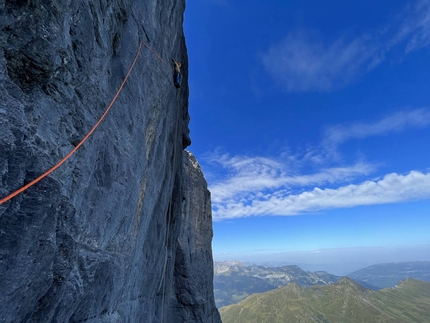
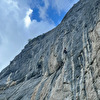
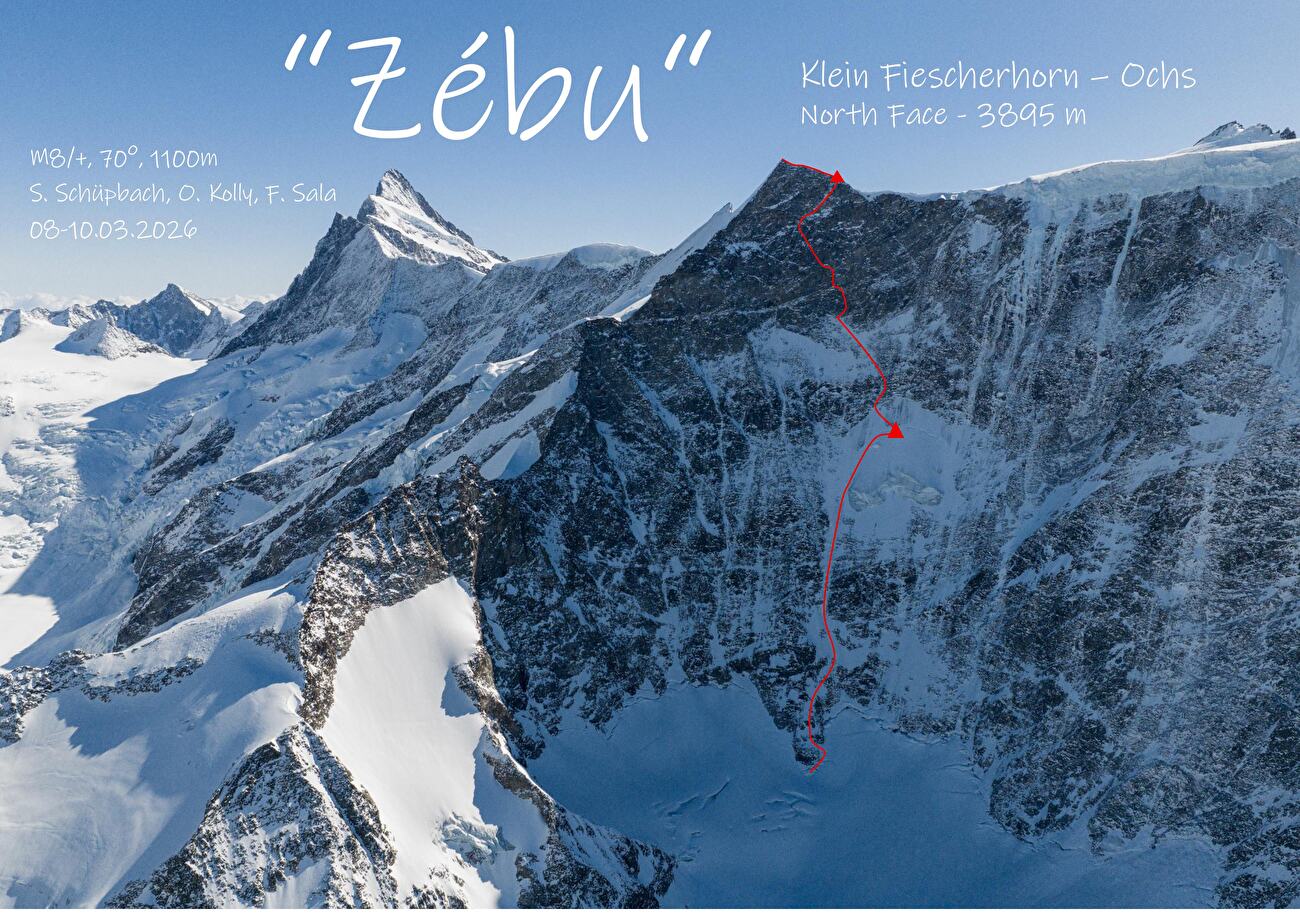
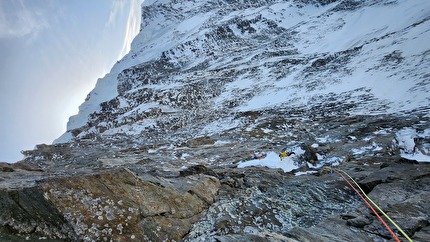
The northwest face of the Klein Fiescherhorn – also known by some as the “Ochs” – is one of the great yet surprisingly little-climbed walls of the Bernese Alps. The face, around 1100 meters high, is clearly visible from Grindelwald and from afar almost appears inviting. However, anyone who looks more closely will notice the steep, often loose rock in the upper part of the wall and a wild structure that offers few obvious lines. It is therefore remarkable that the wall had previously only one route: the line established by Mäusy Lüthi and Hermann Steuri in 1935.
This route was first repeated in winter only much later, in 1981, by Michael Boos and Patrick Hilber. Despite this history, the northwest face still offers plenty of space for new ideas. However, our project did not begin as planned. A week before our successful ascent we had to abandon a first attempt: Jonas Schild was hit by a rock and suffered a concussion. Jonas is tough and descended to Grindelwald with us under his own steam, but the wall made it abundantly clear that it must be taken seriously.
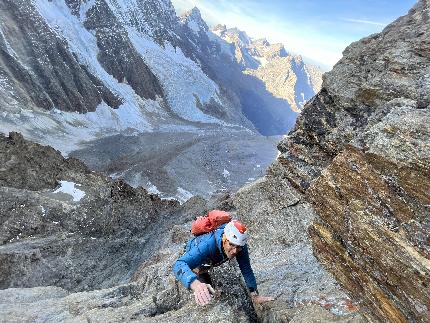
On the morning of March 8, we – Filippo Sala and Olivier Kolly and I – started from the Eismeer railway station. With skis we traversed beneath the immense northwest face to the base of the wall, where we left our skis.
The lower section of the wall proved surprisingly pleasant: steep ice, mostly around 60° to 70°, which allowed us to gain height quickly. The line almost presented itself, always weaving between ice runnels and snow-covered rock steps. About halfway up the wall we reached the hanging glacier, whose Bergschrund offered us a perfect bivouac spot. Sheltered and surprisingly comfortable, we spent the night there – directly below the massive barrier of the summit wall.
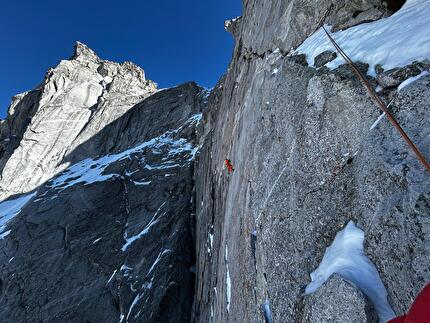
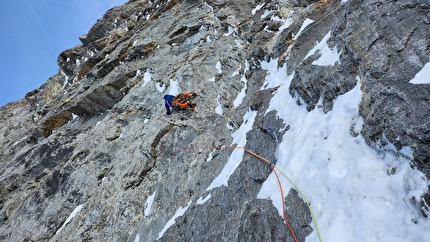
The next day we stood below the decisive section: about 400 meters of nearly vertical to overhanging rock. From below the wall appeared dark and forbidding – and the closer we came, the clearer the complexity of the face became. Compact, overhanging zones presented (too) great a challenge. Only a ramp running diagonally to the left seemed climbable, although very loose.
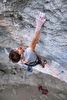
Olivier was not to be envied for leading the two most difficult pitches. With impressive composure he worked his way across a compact slab (wearing crampons) and through overhangs made of frozen-together blocks. Every move required complete concentration; every hold had to be carefully tested. Fortunately, the upper part of the summit wall became somewhat more moderate. Nevertheless, finding solid protection and usable belay stances remained a constant challenge.
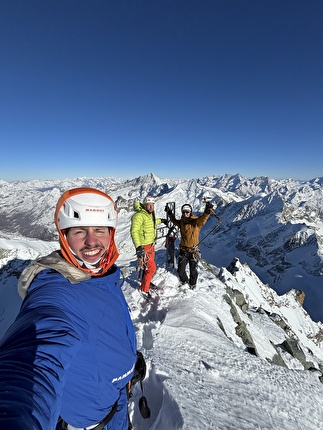
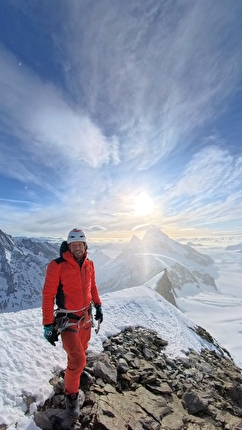
As we gained height the weather steadily deteriorated. The wind increased and bivouac spots in the steep upper wall were almost nonexistent. For this reason we decided against a direct exit to the summit. Instead, near the top we traversed out of the wall to the right and eventually reached the ridge about 40 meters below the summit of the Klein Fiescherhorn.
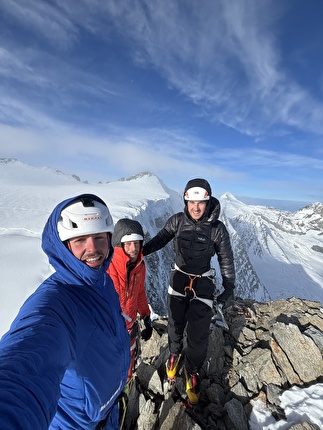
The wind continued to increase as we descended the south side for about 150m. Only around midnight did we find another suitable bivouac spot – once again in a Bergschrund. After a short night, we set off again on the morning of March 10 and climbed to the summit. Afterwards we rappelled the entire face from improvised anchors – a long and focused descent down the huge northwest wall. Our skis were waiting at the base. The ski descent back to Grindelwald felt almost surreal after the intense days on the wall. Tired but satisfied, we finally reached civilization again.
The northwest face of the Klein Fiescherhorn once again showed us how much adventure is still possible in the Alps today – especially on walls that are clearly visible yet rarely visited. And perhaps that is exactly what makes this face so fascinating: despite its imposing presence, it still offers space for new lines.
For us, a zebu is an ox with a bump – the ox represents the mountain (Ochs) and the bump represents Jonas' injury – it's a pitty he couldn't be there for the second attempt. For myself, this is the fifth wall of the project "The 6 forgotten north faces of the Alps". The fourth with Filippo and the second with Olivier.
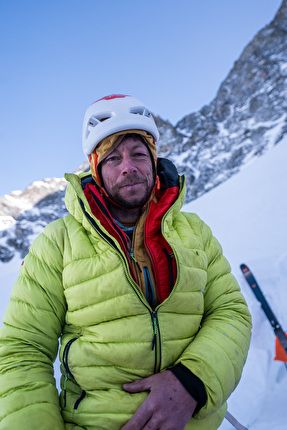
Silvan Schüpbach, Thun, Switzerland
 See all photos