


 Nicholas Hobley
Renato Casarotto's historic first winter ascent of Diedro Cozzolino on Piccolo Mangart in the Julian Alps

 Copia link
 1 / 4Nicholas Hobley
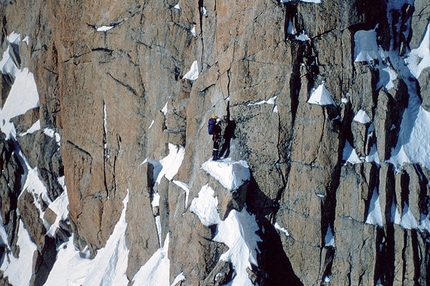
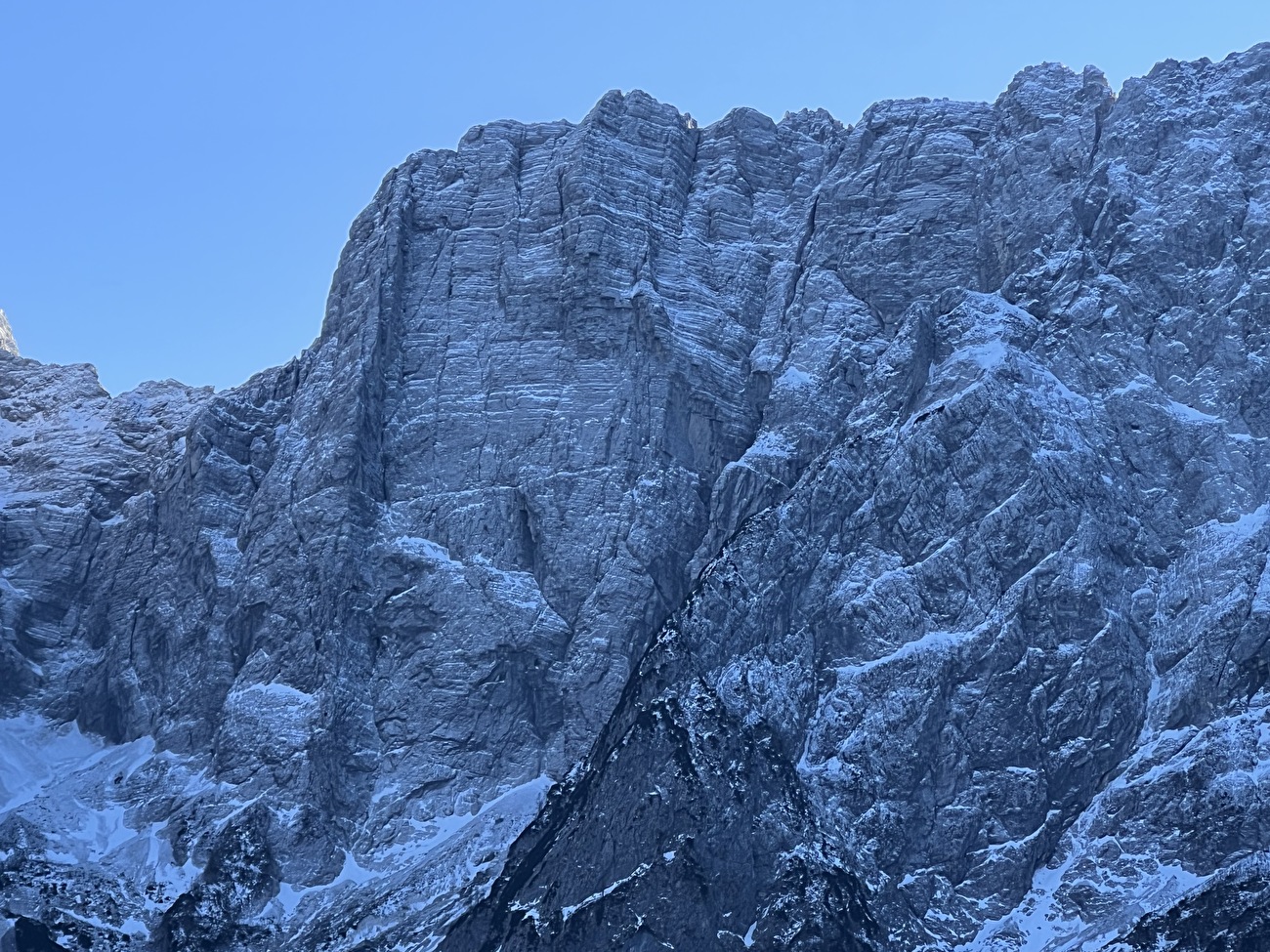
On 30 December 1982 Italian mountaineer Renato Casarotto set off on one of his most important climbs: the first winter ascent of the impressive Diedro Cozzolino on the North Face of Piccolo Màngart di Coritenza, the 2677m peak that straddles the border between Italy and Slovenia.
At the time, the great Italian mountaineer had already completed his epic Freney trilogy, ie the solo linkup over a period of 15 days in February 1982 of the three great routes on Aiguille Noire de Peutèrey, Picco Gugliermina and the Central Pillar of Frêney the Mont Blanc massif, but the North Corner on Piccolo Mangart first ascended by Armando Bernardini and Enzo Cozzolino in 1970 pushed him to the very limit of what was humanly possible.
For the next 11 days, Casarotto was completely alone on the wall, in one of the coldest corners of the Julian Alps, watched only by his wife Goretta as he slowly clawed his way up the nigh 1000m line. The rock was completely encrusted with snow and ice, the temperatures hovered constantly at -20°C and the conditions were so prohibitive that on one particular day he managed to make a mere 20 meters of progress. "From a technical point of view," Casarotto would explain later, "this was my most difficult winter climb of all."
Casarotto's solo ascent of Diedro Cozzolino is one of the absolute masterpieces of winter mountaineering, a testament to his immense skill and immeasurable tenacity. It is hard to imagine a similar feat being carried out nowadays, times have simply changed too much. This is why we are publishing the original account of the historic ascent, written by Renato Casarotto himself shortly after his undertaking for the magazine Alpinismo Goriziano of the Italian Mountaineering Club's Gorizia section, whom we thank for their permission.
THE FIRST WINTER ASCENT OF THE NORTH CORNER OF PICCOLO MANGART DI CORITENZA by Renato Casarotto
I have a very precise concept of winter ascents, one that I adhere to faithfully: they should not be a way to add my name next to a route, merely because it was climbed in a season different to the ones in which the mountain is normally climbed.
For a winter ascent to be truly such, it must possess its own peculiarity, that is, it must be a new climb for the person attempting it and, consequently, not previously known to them during the summer season. Only in this way does a winter ascent become more than a simple repeat and retain the allure of risk combined with difficulties expressed at the highest level. Winter ascents demand all of a climber's experience as well as constant training, both physically and psychologically.
I only climb in winter if I feel I am acting in accordance to this principle, convinced that only in this way can one find the satisfaction of a true first ascent, just as I did last winter on Mont Blanc.
This year, I couldn't aim for less, especially since this perhaps overly bold project had been maturing in my mind for some time: the great North Corner of Piccolo Mangart di Coritenza, a mountain I had glimpsed through the mists four years ago.
Standing 2,393 meters tall, Piccolo Mangart is one of the best-known peaks of the Julian Alps, alongside Jôf Fuart, Jôf di Montasio, Véunza, and many others.
The Julian Alps are unjustly neglected by classical mountaineering, for they possess exceptional alpine attractions and relatively easy access. The climbs themselves are very severe and committing, as they take place on compact rock, rock with blind, sparse cracks where few pegs can be used.
Winter presents an isolated environment with the most severe temperatures; indeed, winter alpinism in the Julian Alps remains a sporadic occurrence.
All these components attract me.
There is peculiarity, originality, the unknown.
On Piccolo Mangart exists the most grandiose corner in the Alps.
This route has a history of attempts featuring interesting and illustrious names.
This imposing corner, a full 800 meters high, was first climbed by Enzo Cozzolino from Trieste in 1971. For four years, the corner on Piccolo Mangart has lingered in my mind. And now I am finally before it.
What I feel is not an impression of powerlessness, but the desire to challenge myself against this colossus. Having received confirmation of favourable weather conditions for my attempt, I begin the climb on the 30th of December 1982.
The mountain is completely new to me, and therefore I cannot foresee places where I might bivouac. I set off with confidence, but not convinced I can victoriously complete my attempt. Fro Capanna del Cacciatore at Alpe Vecchia, at an altitude of 1,500 meters, my wife Goretta will follow through her binoculars my long ordeal, which will last a full 11 days, with ten bivouacs.
The first day is truly promising, as it allows me to gain 150 meters of the 800-meter corner.
Then the climb becomes increasingly demanding, and the meters gained drop to 80, to 50, until reaching a mere 20 on the sixth day.
I bivouac on the mountain, while around me the temperature sometimes drops significantly below zero, down to -25°C and -28°C.
I console myself that in the worst years, here the mercury can drop to -35°C!
It is undoubtedly one of the coldest areas in the Alps.
At the end of the sixth day, I can rest more comfortably on a small platform I created after several hours of work, clearing the wall of icy snow with my ice axe. The snow hinders my ascent; in some places, it accumulates in a crust up to half a meter thick. I must remove it with the ice hammer in order to proceed up the great corner, which is articulated with chimneys and walls.
On the ninth day, I am so engaged and concentrated that I barely notice, thanks to a peg left on the wall, that I have already reached the Della Mea variation. On the entire route, I encountered only four peg.
On the penultimate day of my ascent, it snows. The bad weather does not disorient me. By now, I sense the summit is near: indeed, I reach it at 9:30 AM the following day. I finally feel fulfilled.
Eleven days are long to face in solitude on a difficult route, with a cold that increases the hardship to the limits of possibility.
I, too, had to fight against the temptation to give up and return to the comfort of a house and a bit of warmth.
My gear of about 50 kg included: 2 ropes of 50 meters each, 11 mm in diameter, 20 pegs, some carabiners, crampons, an ice axe, an ice hammer, double plastic boots, a Gore-Tex bivy tent; plus food and clothing.
At around 10:30 AM on the 9th of January 1983, I begin my descent into Yugoslav territory with three magnificent abseils. That same evening, I am back in Tarvisio.
I am made an honorary citizen by the people, who in ever-increasing numbers had followed my climb.
They see me as one of them, and I too am happy to be recognised as such. I am grateful to them, particularly to Silvano, Nazzareno and Roberto, and all those who willingly sacrificed their time for me.
These magnificent people enter my heart, and I will never forget them. I want to return among them soon to talk, to feel myself among friends, and to climb the faces of their beautiful mountains.
Renato Casarotto
Alpinismo Goriziano
nr. 1 -January/February 1983
Link: www.caigorizia.it