


 archivio Matteo De Zaiacomo
Azzardo Estremo on Sckem Braq in Pakistan by Chiara Gusmeroli, Matteo De Zaiacomo

 Copia link
 1 / 17archivio Matteo De Zaiacomo
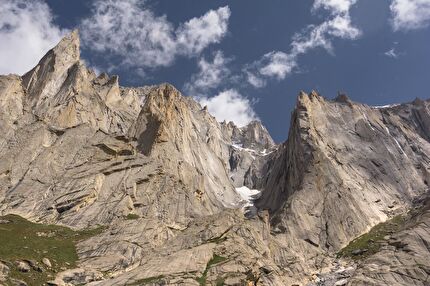
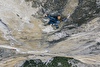
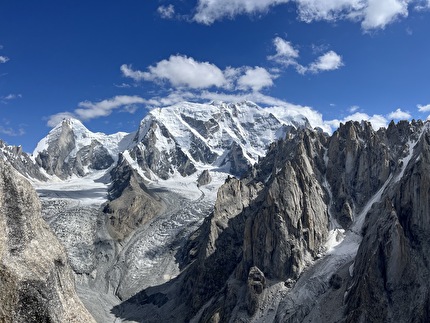
Nangma Valley has often been called the Yosemite of Pakistan. Seeing walls like the one on Amin Brakk with my own eyes confirmed this place's reputation. Vertical granite walls stretching as far as the eye can see — a true paradise for climbers. Largely unexplored since the major ascents of the late 90s and early 2000s, the valley still leaves room for imagination, with its beautiful peaks and pillars of perfect granite awaiting their first ascent.
This expedition to Pakistan was born out of the enthusiasm of wanting to visit and discover the Karakorum: when the opportunity arises, you can't let it slip away. We only had 20 days at base camp at our disposal, and this valley is home to walls ranging from 4,000 to 6,000 metres in altitude. This meant we had a relatively short acclimatisation period and, fortunately, fairly simple logistics: it only takes three days to travel from Italy to base camp, one by plane, one for organisation and a final day travelling by jeep from Skardu plus trekking. Nangma Valley was the perfect choice.
Setting off as a team of two is a choice that leaves no room for compromise. You know you can only count on your partner and vice versa, sharing motivation, doubts, and difficulties. Chiara Gumeroli and I had all the most famous mountains with already climbed routes in mind, but once we picked up our binoculars, we were amazed at what we could still come up with.
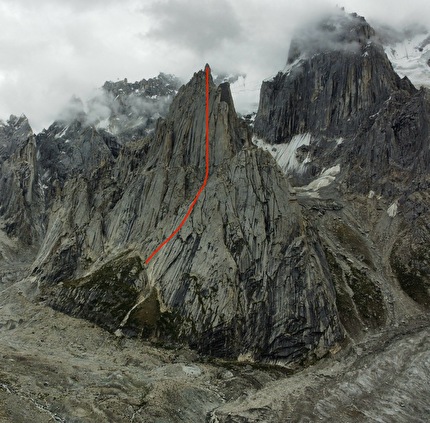
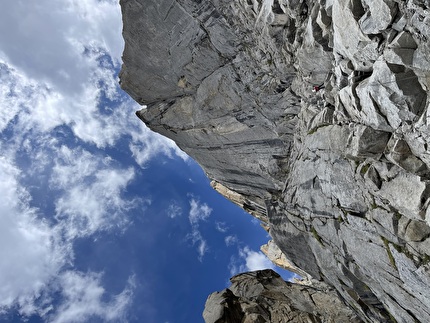
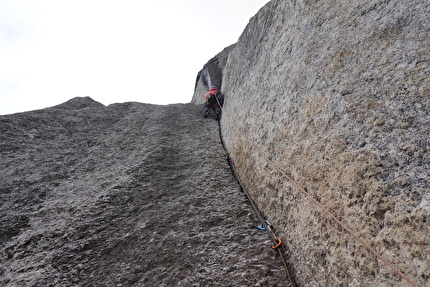
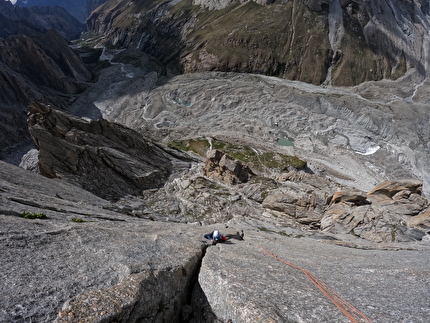
At the head of the valley, standing out unmistakably, is Skem Braq! Even from the village of Kande, you can glimpse the final headwall of this mountain, but we have no information on any previous ascents. In any case, there is a line that immediately captures our attention, a crack that climbs straight up, surmounting a steep, compact wall. Reaching the base of that wall doesn't seem too complicated, but climbing it turns out to be an adventure full of twists, risks faced and, fortunately, avoided. In addition, the days of intense cold cost me the sensitivity in my toes for a few weeks, a few expletives and the determination not to throw in the towel.
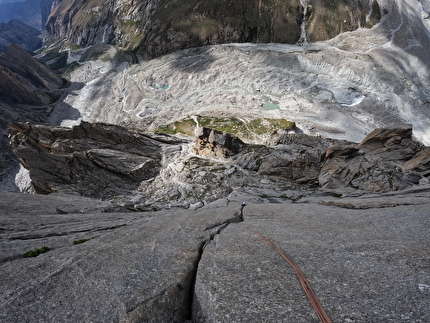
We make a first attempt, traveling light, convinced that we will be able to climb the 900-metre wall in just two days. After reaching the ledge following a more difficult first section, morale is high. The following day, we tackle the headwall and the line identified through the binoculars proves to be amazing, meter after meter, a difficult climb, always in cracks. And with a few scares, when I only take the same two cams of the same size with me for 30 metres!
We reach a point where the cracks become shallower, smaller and more superficial, and we find them full of grass. Progress slows terribly. Evening comes quickly, and we have neither enough food nor enough good weather to continue. We return to base camp with all our gear on our backs, disconsolate but happy to have been able to climb effectively even at high altitude.
Still on our way back to base camp, we look at Shingu Charpa and its magnificent west face, where we spot a new potential line. We are motivated and know that once the bad weather passes and we are properly rested, we can launch our attempt. Suddenly, however, we fall into a state of confusion and fear: before our eyes, the west face collapses, covering the valley floor in dust and shattering our convictions.
Nothing to be done. At this point, we decide to go back and settle the score with the wall of untouched Skem Braq. We organise to stay on the mountain for more days, bringing more gear, pegs, and even a small ice axe to clean some short sections of grassy cracks.
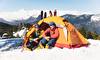
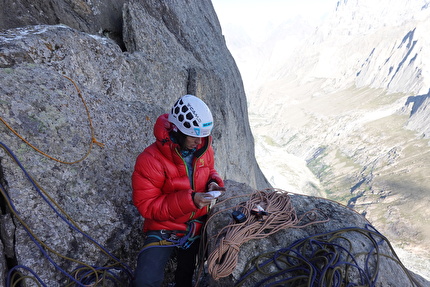
We climb the section we already know on the first day up to the ledge. On the second day, we climb the headwall, rigging some belays to speed up the descent. Just as we are on the ledge, a major rockfall hits the lower part of the route, and we thank heaven we are already above that section and not at the base of the wall. On the third day, it rains, and we rest in our tent on the large ledge.
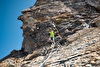
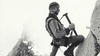
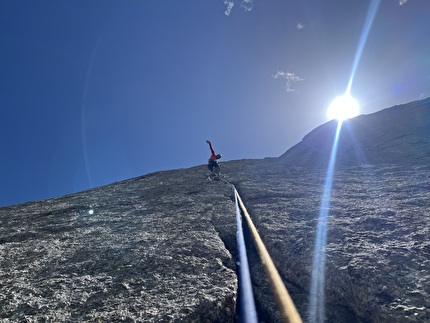
The fourth day is the decisive one! We reach the highest point from the first attempt, and we are fast enough to still have many hours of daylight to solve the section that had turned us back a few days before. We climb slowly, pitch by pitch, climbing free and stopping to clean the cracks, alternating with aid sections. Then I find myself leading what turns out to be the nastiest pitch of the route, though I don't know it yet. I spend 3.5 hours breaching an aid section, with pendulums, a thousand doubts, Totem Cams placed on two cams in flared cracks, along with expanding flakes and pegs hammered in just a few centimeters and choked with slings. When I check the time, I can't believe that so much has passed; it was all so frantic, I never stopped moving my hands, searching for the ideal solution. I reach the belay exhausted. With a final pitch, we definitively overcome the headwall; it's now beneath our feet, and we collapse, spent, in a makeshift bivouac.
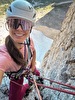
Chiara wakes up and puts on her harness at 5 a.m. Or perhaps she never really closed her eyes. In any case, she sets off on a steep pitch in a corner. Halfway up, it starts to snow, but neither she nor I even consider going down: we are so close that if the price is having to climb in the snow, then we'll pay it! Having come this far, we are not at all willing to give up!
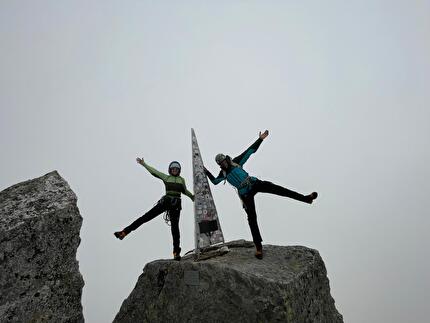
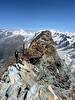
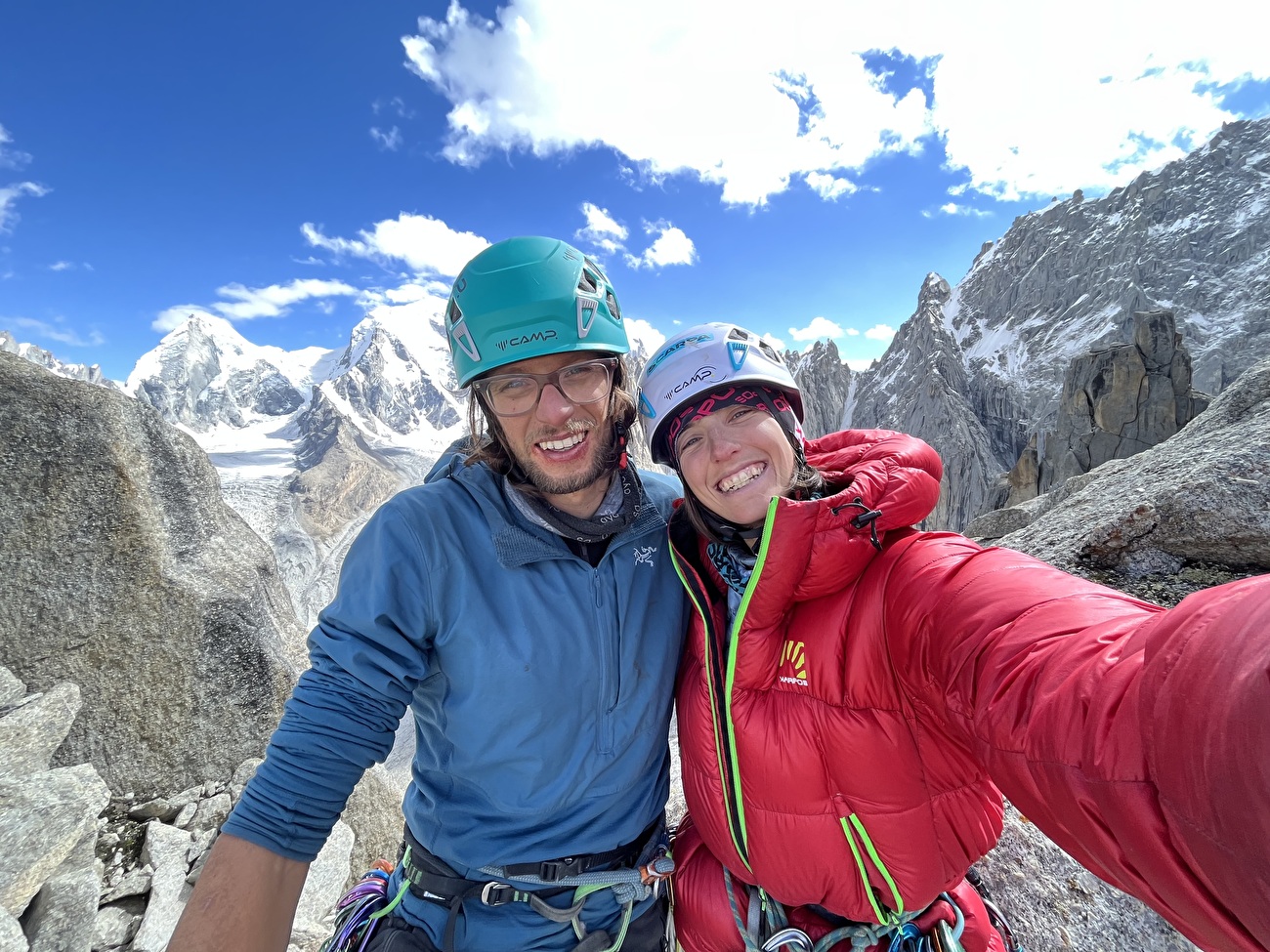
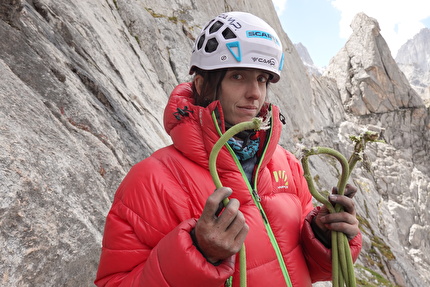
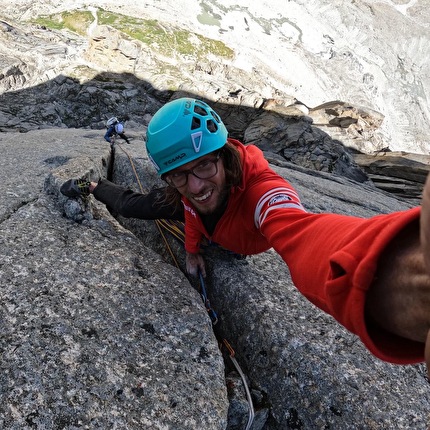
Four hours later, we set foot on the summit, and suddenly the sky clears. And there we are, enjoying that special moment we desired so much that we are almost disoriented, barely able to grasp that it has truly happened. Happiness and satisfaction are written on our faces.
On the way back, we find our tent, left on the ledge, riddled with holes from a rockfall that came down during the last night. Once again, we only realise in hindsight how a paradise can transform into hell.
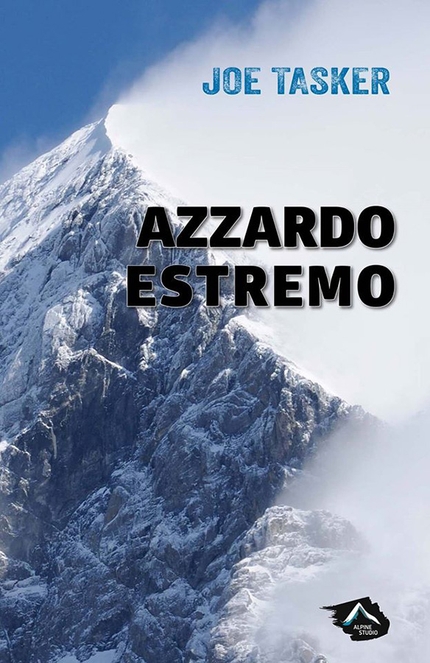
The name of the route was chosen during one of the base camp dinners: our gaze simultaneously falls on a book written by Joe Tasker, Savage Arena, translated into Italian as Azzardo Estremo, Extreme Gambles. We think of Tasker and Boardman on Changabang, and in our own small way, we imagine ourselves like them, bivouacking on the wall, overcoming difficulties with our own strength. Then we think back to the risks we took, and the name seems perfect to us.
Azzardo Estremo is the first route to climb the summit of Skem Braq (approx. 5,300m) in Pakistan, a mountain that provided us with us a fantastic adventure and an exciting climb. It may not have changed our lives, but perhaps it left a small, indelible mark on our character.
We thank all the people who supported us: the Italian Alpine Club (CAI) Nazionale for believing in a project of this kind, the Ragni di Lecco, and our technical sponsors. And, of course, those waiting for us at home.
by Matteo De Zaiacomo
Matteo thanks CAI nazionale, Ragni di Lecco, Go Vertical, SCARPA, CAMP, Totem Cam
Chiara thanks: Cai nazionale, Karpos, CAMP, SCARPA
 See all photos