


Piolet d'or 2006 awarded to Prezelj and Lorencic for Chomo Lhari

 Copia link
 1 / 20
 Giulio Malfer
Group photo of the 16th Piolet d'or
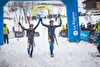
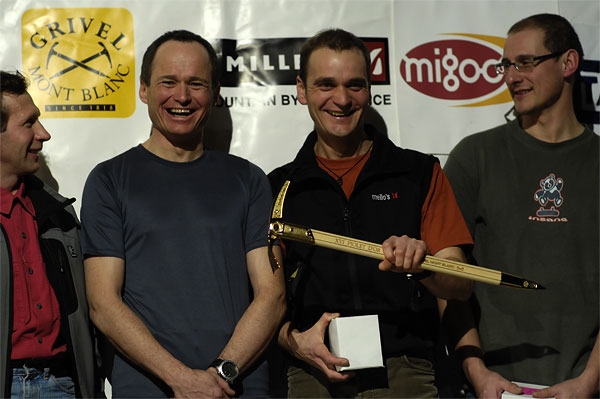
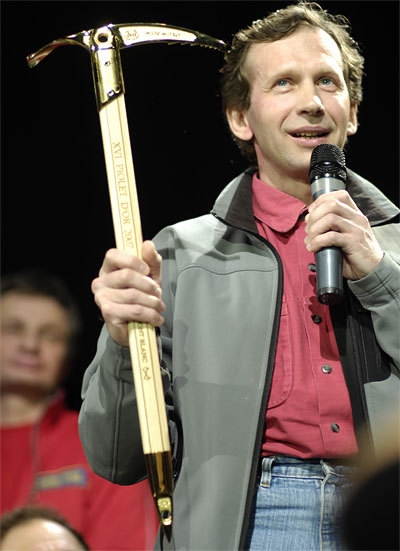
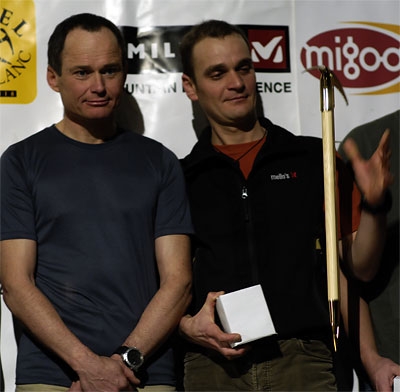
One could start with a snapshot to recount this latest Piolet d'or. Naturally Marko Prezelj and Boris Lorencic are in the photo, raising the Piolet d’or 2006 which they received for their beautiful route on Chomo Lhari. And right next to them is Pavlev Kozjek, still incredulous for having just received the Spectator's Choice for his solitary sprint up Cho Oyu. Close to them there's a lively Denis Urubko who, utterly convinced, is applauding the winners. And just a bit to his side - but almost on a different planet altogether with his expression which transmits goodheartedness and strength - one notes Serguey Samoilov, Urubko's partner on the new route up Manaslu. The smiles of Tim Emmet and Ian Parnell beam out from the center, and it was they who gave this year's Piolet the "spirit" (read enthusiasm and new creativity) with their new route on Kedarnath Dome. Igor Chaplinsky's moustache, and verve, cannot remain unnoted either: together with Andrei Rodiontsev and Oret Verbitsky he created a beautiful line up Shingu Charpa and in doing so he taught all that mountaineering (even that of ideas) is a timeless affair. The sound, which the photo is unable to provide, is the applause of crowd. And what the photos cannot render are the stories which sparkle in the climbers’ eyes during this 16th edition of the mountaineering Oscars. This is perhaps the best part of it all. And definitely the one worth recounting.
Stories of men, mountains, rock faces and dreams
The Piolet 2006 is all about stories dreamt of, chased and realised on distant mountains (this year all ascents took place in the Himalayas) and via new routes. Naturally they are all different stories and difficult to compare, since in mountaineering one lives for the (unrepeatable) moment of action which is unique and never again equal. All ascent have the same passion and direction in common. Or, better still, a research called "alpine style", the true dream of mountaineering. This starts with an idea (the mountain, the rock face, the line) which is chased and dreamt of incessantly. Then, when the "game" really begins, one sets off for the summit, naturally without ever returning back to base. And it's a journey which is undertaken by a select few, fewer, or even completely alone because the end of the means is to climb lightweight and fast while searching for a new line, for new mountains, new walls and new limits, both personal and to mountaineering as a whole. The ingredients for success are much the same, too: ideas, the search for adventure and the desire to put oneself to the test (in all senses). To all of this there must also be a good dose of luck... or rather, awareness and knowledge in taking the right decisions in order to manage to understand, accept and overcome the infinite number of variables the mountain holds in store (above all in these Piolet ascents). The interpretation counts too; the how, the most important factor in this context: mountains, routes, mountaineers and their means all melt into a perfect experience. But, as all know, perfection is not attainable, it can only be chased after...
Chomo Lhari, a perfect mountain for Marko Prezelj and Boris Lorencic
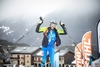
Great moments repeat themselves throughout history although, admittedly, none can ever be exactly the same as before. Something of this sort happened on Friday evening at Grenoble when Marko Prezelj and Boris Lorencic raised the golden ice axe of the 16th Piolet d'or. In the glimpse of an eye. A flashback to imagine that young Marko who, together with Andrei Stremfelj, raised the golden ice axe during the first edition of the most prestigious mountaineering prizes sixteen years ago. The focus immediately shifts back to today, to those profound and serious eyes which have seen much, which have experienced plenty of mountaineering based more on "facts" then words. At the time, during the 1991 edition, Marko was rewarded for his fantastic new line up the immense South Face of Kangchenjunga. Now, sixteen years on, that ice axe is his once again. Once again for another new route, this time up Chomo Lhari, a perfect mountain which lay in wait for a perfect interpretation: yes, the one which the two Slovenians carried out last October.
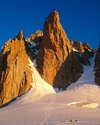
A return to the past therefore? No, not if you think about the altitude (7326m) of the magnificent Chomo Lhari. Not if you think about the difficulty (VI engagement and M6+ at high altitude). And not if you think about the length (1950m) of the route. Decidedly not if you look at the lightweight nature and speed of the ascent, and if you analyse the perfection and beauty of it all. Of the mountain, its surrounding landscape (the immense Tibetan desert) and that ethereal line which has now been traced up its NW Pillar. It's difficult to elude Chomo Lhari's charm. It's impossible not to be taken in by the route which Prezelj patiently dreamt of for ten years and which, in the end, he climbed together with Lorencic in 4 days of ascent and 2 days of descent. When presenting his climb to the jury, other mountaineers and journalists on Friday morning Marko exclaimed that he had come to recount his story. A story, he added with a smile, which like all those mountaineering stories, is true to a great extent... To me it seemed beautiful. Like the part when his climbing partner persuaded him to continue just as he (the leader) was about to give up. It goes without saying that Prezelj is "tough". Someone who doesn't ever "spice" his stories. The ascent is what counts for him. And for me Denis Urubko's phrase after the ceremony counts for much: "I respect Marko!" And Pavlev Kozjek's remark is equally important "I know Marko well. If he needed 4 days to climb his route then it means it's impossible to climb it in less." These words, and the respect of all the other mountaineers, say it all.
Cho Oyu speed for Pavlev Kozjek
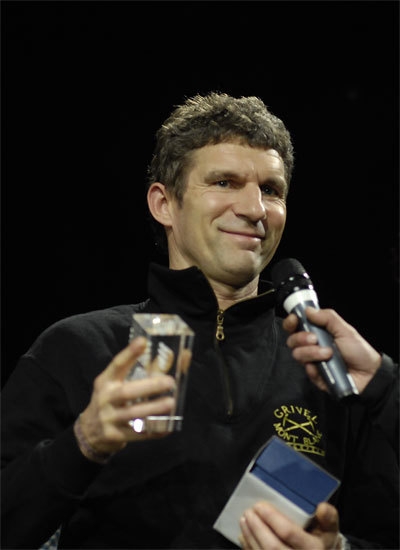
When you think about a new route up the 8201m high Cho Oyu raced solo in less than 15 hours from base camp, with the minimum amount of gear, then you expect some sort of marathon extended to high altitude. But when you analyse the difficulties (VI “engagement” and 4+ at 7200m) then you immediately realise that there is much more to this, that there's a true mountaineer behind it all. And when you meet Pavlev Kozjek there can be no doubts whatsoever. A gentle giant, with two enormous shoulders. A mountaineer with first ascents on Cerro Torre, and Shisha Pangma, and solos on great walls in the Cordillera Blanca. You realise that you’re standing face to face with a great mountaineer and a man of great calibre. If he talks about Cho Oyu, the first thing he recounts is the tragedy he witnessed immediately before staring his incredible ascent. The Chinese Army killing of three Tibetans attempting to cross the border into Nepal literally shook and disturbed Kozjek. He was the one who first transmitted the photos of the killing (and assassination) throughout the world. "Afterwards if was hard to set off for the summit... I did it with death in my heart" he added. But Kozjek succeeded in his great ascent. And in so doing he rendered the highest mountains in the world naked and vulnerable to what can still be done in the future. He did it, and this shouldn't be underestimated, at 47 (!) years of age. So the Spectator's Choice was awarded perfectly once again. It's curious to note that the two Piolets (Jury and Spectators) went to two Slovenian mountaineers. And Pavlev added that Slovenia is comprised of just two million people...
Denis Urubko and Serguey Samoilov double take on Manaslu
After their (great) new route up the S Face of Broad Peak (8047m) climbed in 2005, Urubko and Samoilov repeated a similar fear in 2006 with a new route up the NE Face of Manaslu (8163m). Two new routes climbed alpine style in just two years on the 8000m peaks is almost a record in its own right... It didn't come about by chance therefore that the ascent carried out by two Kazakh mountaineers was rewarded with the first ever Piolet d’or Asia and that they were nominated for the Piolet d'or for the second year running. If you ask Denis about how the two routes differ, he'll say that Broad Peak was technically more demanding but that Manaslu was definitely more dangerous. Just glance at the massive seracs which loom above the first section of the mountain and you'll immediately take his word for it. And the rocky final section was by no means a walkover either, seeing that the 6a+ grade they gave is worth double at that altitude. Four days ascent and two days descent give a clear idea of what Denis and Serguey are capable of. Another glance at the photo reveals how deep the snow was. Add to this the amount of gear, stripped bare to the bone (just one sleeping bag, 1 duvet jacket, very little food etc)... Well, you get only a slight inkling of how much fatigue (infinite) these two can bear. All that remains to be said is that Denis described his alpinism as follows: "As a young boy I read books about Messner. It's because of this that I've always dreamt of climbing 8000m peaks in alpine style, on-sight and via a new route" Denis is truly living out his childhood dreams, 100%!
Ian Parnell and Tim Emmett, the future on Kedarnath Dome
Tim Emmett has a passion, excuse me, many passions. He is one of the most famous rock climbers in Britain and his activities touch rock in all its dimensions, from deep water solos to the crag, via hard grit trad routes... Just think that he often teams up with Leo Houlding and together they enjoy themselves base jumping. But Tim doesn't disdain mountaineering either and he proved just this when the highly experienced Ian Parnell asked him (at a party, naturally) to climb together on 6830m high Kedarnath Dome. Once said, immediately done. The two Brits ascended the SE pillar in 6 days, finding the perfect way (the most logical and easiest line) to climb the 2000m to the summit. Close to the top Tim climbed the crux 6c pitch but according to him, the "extremely friable" 6a rock start proved more demanding psychologically. Tim exclaimed that he experienced a very particular moment when he realised he had past the point of no return... A smiling and relaxed juror, Steve House, immediately replied: "Welcome to alpinism, Tim..." Yes, welcome. Your enthusiasm and high spirits (behind which, all know, lies immense strength) can do us all a world of good.
Igor Chaplinsky, Andrei Rodiontsev, Oret Verbitsky and the (beautiful) Shingu Charpa
Igor, you're a legend! is what Tim Emmett said on stage in Grenoble. And yes, we think so too! The Ukranians Igor Chaplinsky, Andrei Rodiontsev and Oret Verbitsky made the first ascent of a beautiful route (both logical and esthetical) up the fantastic Shingu Charpa (5600m). The three climbed past 7a+ rock, M5 delicate mixed close to the summit and "engagement" graded VI in 5 days ascent and 2 descent. Obviously in alpine style. "Three is the best number for a climbing party" Igor declared. "And if you have to make some important decisions democracy rules. Even if, at the end of the day, I get to make the final decision!" he immediately added laughing heartedly. Ay yes, because this form of "lightness" is good for alpine style, as well.
See you all at the Piolet 2007, definitely with other (great) stories!
Vinicio Stefanello
A personal and special thanks goes to the entire jury with whom I had the honour of working with: Yuri Koshelenko (super president, Piolet d'or 2003), Michel Piola (a legend, and Piolet d'or 1992), Steve House and Vince Anderson (Piolet d'or 2005), Christian Trommsdorff (Piolet 2005 nominee), Im Duck Yong (founder of the Asian Piolet d'or) and the editors of Montagnes Magazine.
 See all photos
 |
Piolet d'or 2006 preview |
| Piolet d'or 2005 |
| Parnell and Emmett - Kedar Dome |
| Urubko and Samoilov - Manaslu |
| Pavle Kozjek - Cho Oyu |
| Piolet d'Or Asia |
 | Expo Grivel |